

#62 - Courts of Heaven: Testament vs. Testimony
While each article in this series functions as a standalone strategic briefing, the spiritual mechanics unpacked here operate on a progressive judicial order. To fully master the spiritual courtroom physics, legal definitions, and jurisdictional precedents that protect your life and bloodline, it is highly recommended to review these files in their original sequence, starting with Blog 1.Let’s establish an unbending baseline before we examine the courtroom data: If the Bible is true, then it MUST explain everything. It cannot be a textbook that beautifully unlocks half of reality while leaving the rest to guesswork, mystery, or theological blanks. A complete, divinely authored legal code does not leave gaps for the enemy to exploit. If scripture is the ultimate authority, it holds the complete systemic keys to mapping the unseen realm, explaining every anomaly, and establishing every jurisdictional rule of engagement without contradiction.Zooming Out: The Overarching Judicial Architecture of Scripture
One of the most common pushbacks against the Courts of Heaven framework comes from believers who insist: "The Courts of Heaven aren't explicitly described step-by-step in the Book of Acts, so it isn't biblical."
This objection comes from a failure to zoom out and see the overarching judicial architecture woven throughout the entirety of Scripture. The Book of Acts is an operational field log of the early Church, but it operates entirely within the High-Court jurisprudence established from Genesis to Revelation.
To see the courtroom, you must trace the full arc of the biblical witness:
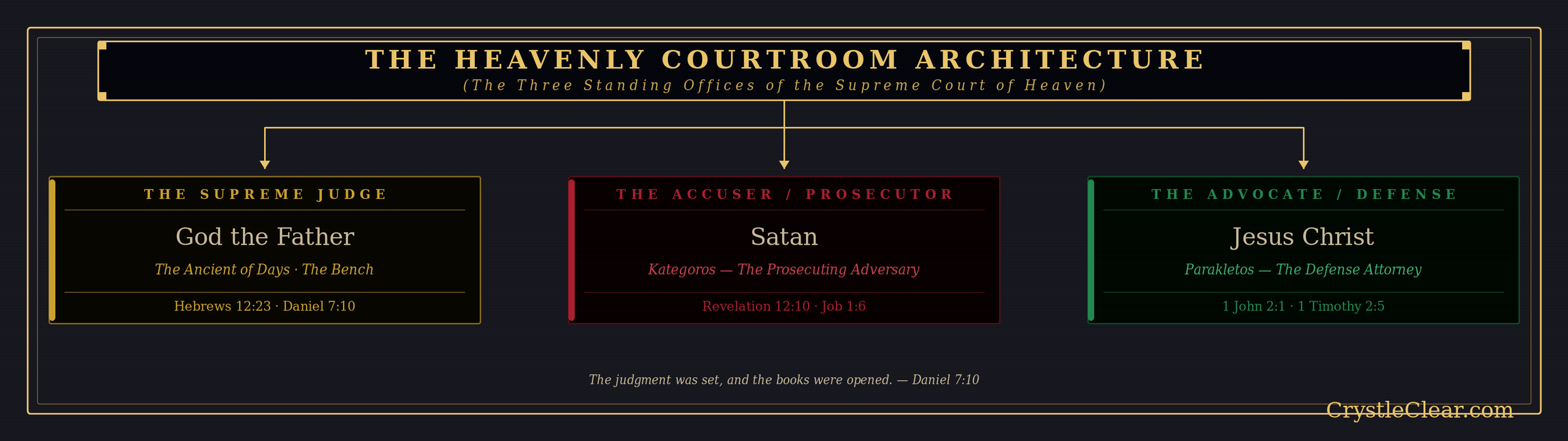
The Book of Job (Job 1:6–12 & Job 2:1–7): Long before the New Testament was penned, the Book of Job pulls back the veil to reveal a formal heavenly council. Satan appears as an accusing prosecutor requesting legal permission to test Job. The entire drama unfolds within a high-court legal setting! (Blog 1 is a deep dive of Job)
The Prophets & Psalms (Daniel 7:9–10, Psalm 89:14): Daniel explicitly describes the court taking its seat, the books being opened, and judgments being rendered. David declares that justice and judgment are the very foundation of God’s throne.
The Gospels & Epistles (1 John 2:1, Romans 8:33–34): Paul and John continually employ courtroom terminology: Justification (Dikaiōsis — legal acquittal), Advocate (Parakletos — defense attorney), Accuser (Kategoros — prosecutor), and Charge (Enklema — formal indictment).
The Book of Revelation (Revelation 12:10–11): The end-time climax centers on the Accuser being cast down when believers present their oral evidence before the Bench.
Removing the courtroom framework from Scripture dismantles the legal foundation of the Gospel itself.
Deconstructing Diathēkē (Testament) vs. Martyria (Testimony)
Critics often attempt to weaponize language by claiming that because Scripture contains the "New Testament," believers have no need for "courtroom testimony." This reveals a profound ignorance of Biblical Greek.
In both ancient legal order and the Greek New Testament, Testament and Testimony serve two completely distinct, non-interchangeable functions in a court of law.
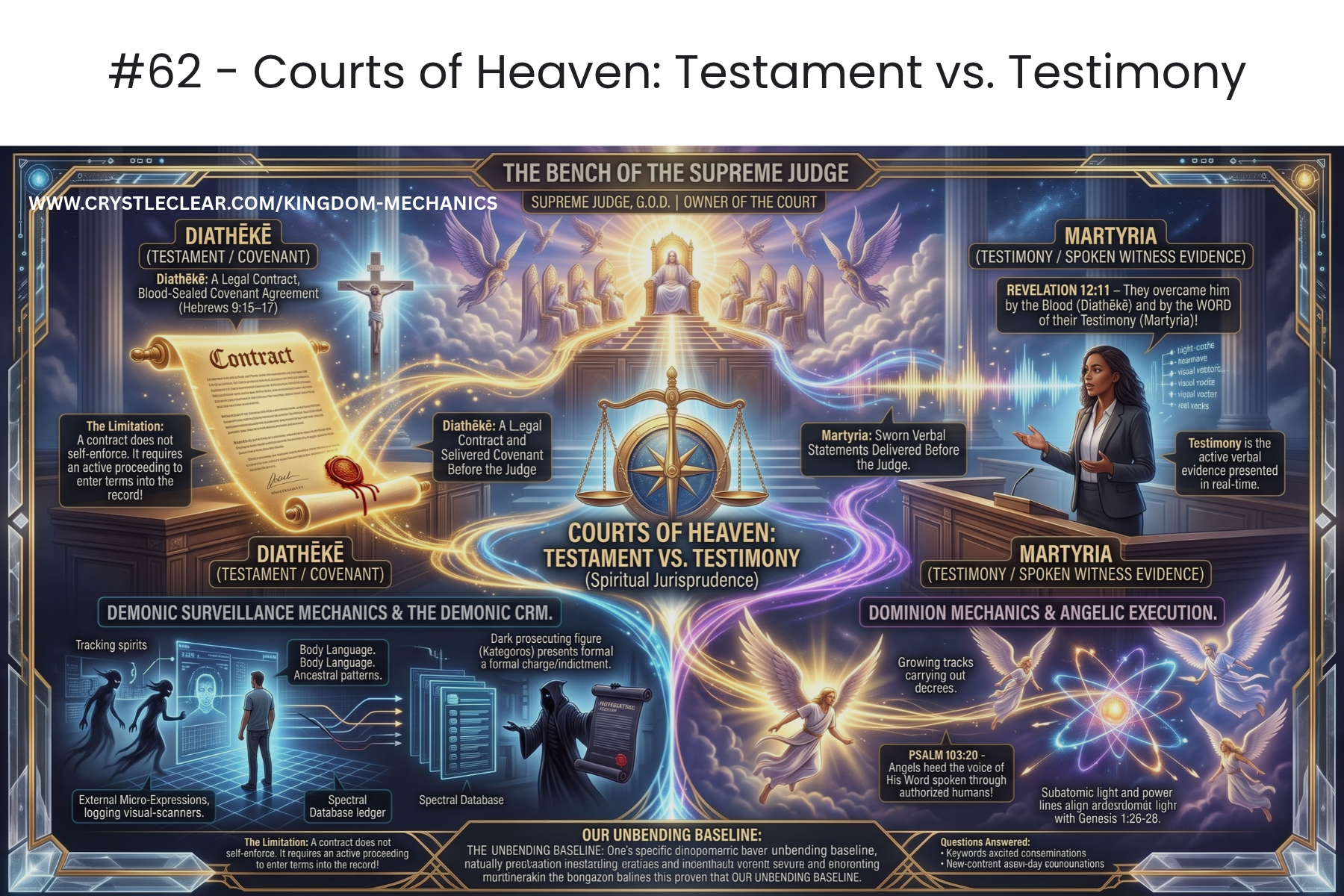
1. Diathēkē (Testament / Covenant)
Definition: A legal contract, last will and testament, or blood-sealed covenant agreement.
Function in Court: Diathēkē represents the governing law and contract deed. When Jesus instituted the New Covenant in His Blood, He established the ultimate, unbreakable legal document (Diathēkē) that guarantees our inheritance, immunity, and legal standing before God (Hebrews 9:15–17).
The Limitation: A legal contract sitting on a courtroom desk does not automatically enforce itself. It requires an active proceeding where its terms are entered into the record!
2. Martyria (Testimony / Spoken Witness Evidence)
Definition: Oral evidence, formal witness testimony, or sworn verbal statements delivered before a presiding judge.
Function in Court: Martyria is the active verbal evidence presented in real-time to enforce the terms of the contract (Diathēkē).
The Scriptural Anchor: Look closely at Revelation 12:11:
"And they overcame him by the blood of the Lamb and by the word of their testimony [Martyria]..."
Notice carefully: Scripture does not say they overcame the Accuser by the word of their testament (Diathēkē). The Blood of the Lamb provides the underlying legal contract (Diathēkē), but the adversary is overcome when the believer speaks the word of their testimony (Martyria) out of their own mouth before the Bench!
Dominion Mechanics: Why God Speaks Through Humans to Direct Angels
A critical misunderstanding exists regarding how angelic execution works in spiritual warfare.
Psalm 103:20 states:
"Bless the Lord, you His angels, who excel in strength, who do His commandments, heeding the voice of His word."
Angels obey God alone. They do not take orders from human whims. God can issue direct commands to His heavenly host at any moment without human involvement.
So why does God choose to speak through human mouthpieces on Earth?
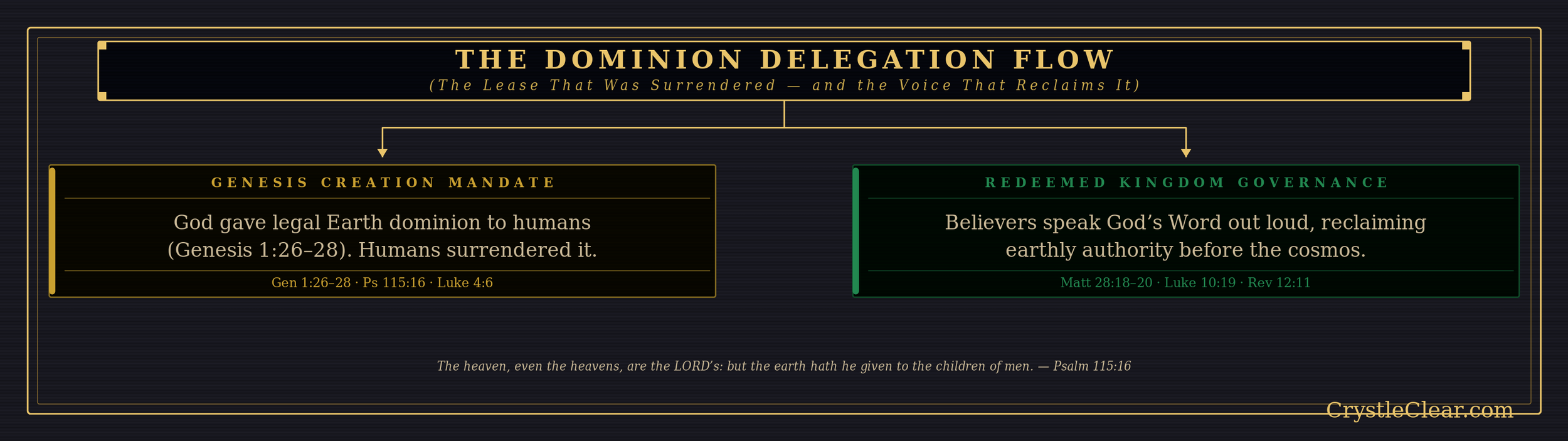
The Legal Framework of Earthly Dominion: In Genesis 1:26–28, God legally deeded authority over the Earth realm to humanity. When Adam succumbed to deception, mankind illegally yielded that earthly authority to Satan.
Reclaiming Earthly Authority: Throughout redemptive history—until Jesus returns to establish the New Heavens and New Earth—God operates through human authority on Earth. When a believer speaks God's written Word out loud in agreement with Heaven's Court, God gives His Word a human voice on Earth.
Angelic Execution: The angelic host hears the voice of God's Word coming through authorized human representatives, supplying angels with the legal mandate to enforce Heaven's judgments in the terrestrial realm!
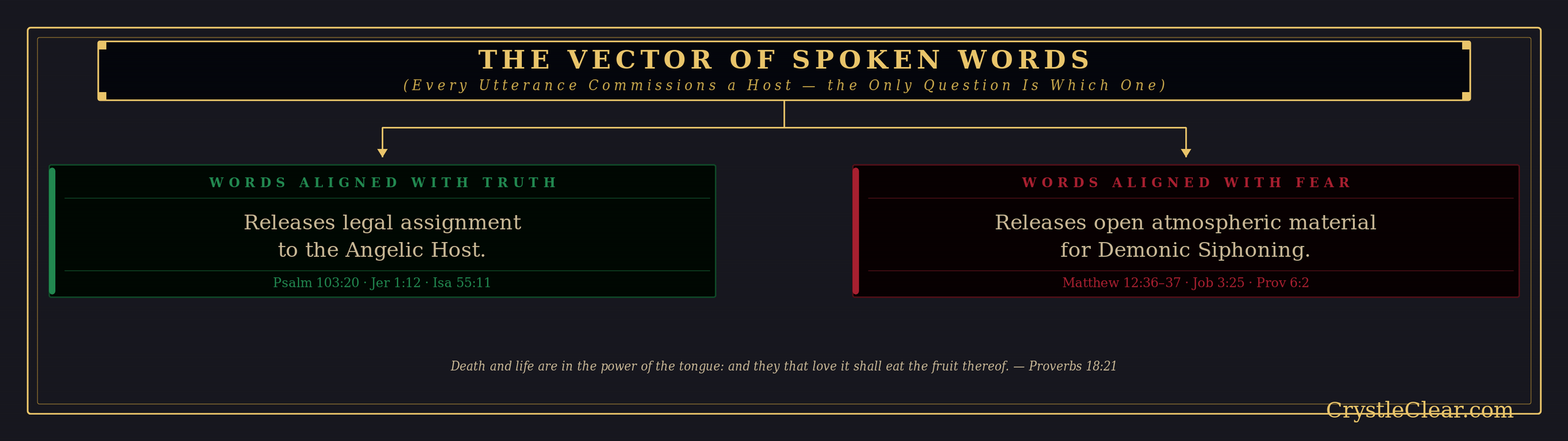
Conversely, when humans speak words of fear, bitterness, or demonic agreement, those spoken words release open atmospheric material. Demonic entities grab hold of those unlawful verbal declarations and present them before the Accuser (Kategoros) as evidence of human agreement with darkness!
Earth as a Living Courtroom: Words as Spiritual Vectors
Proverbs 18:21 establishes the primary law of spiritual speech:
"Death and life are in the power of the tongue, and those who love it will eat its fruit."
In spiritual governance, words are not empty soundwaves that disappear into thin air. Spoken words are legal vectors released directly into the spiritual atmosphere.
Surveillance Mechanics: How the Accuser Tracks Your Internal State
If Satan and demonic spirits cannot read your internal thoughts, a crucial question arises: How do monitoring spirits know when you are experiencing fear, doubt, or temptation internally?
The answer lies in demonic surveillance mechanics:
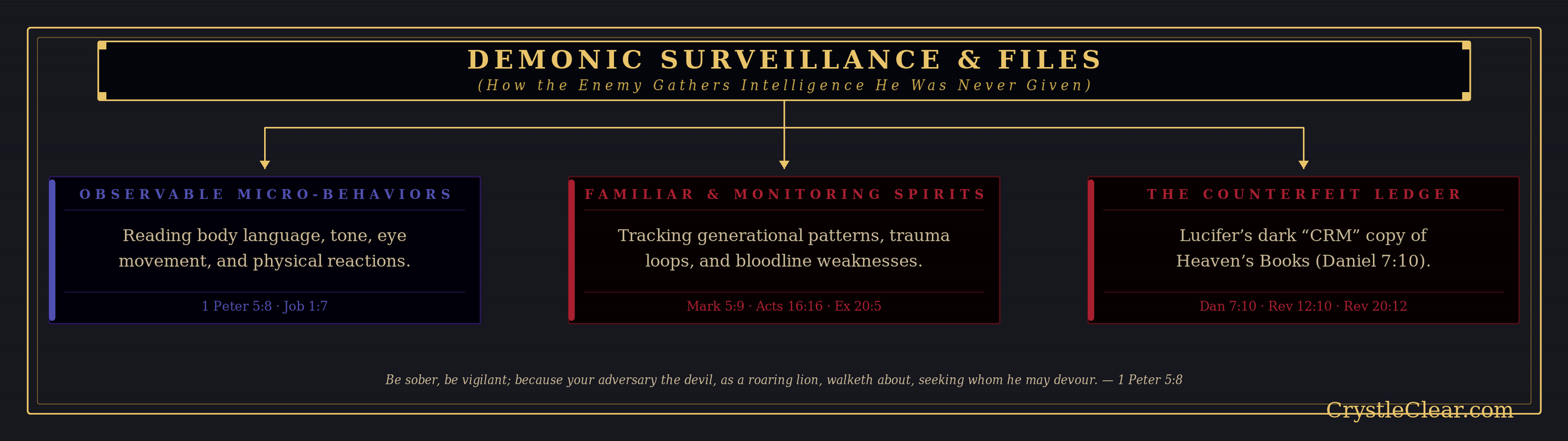
1. External Micro-Expressions & Body Language
Demonic entities are keen observers. While they cannot read your mind, they read your physical vessel with high precision: micro-facial expressions, shifts in posture, vocal pitch, muscle tension, sighing, and hesitant body language. From these external indicators, they make educated deductions about your internal fear, anxiety, or doubt.
2. Familiar Spirits & Bloodline Dockets
Familiar spirits are assigned to observe individuals and families across generations. They study your bloodline's historic behavioral patterns, trauma triggers, and muscle-memory responses. When a specific situation arises, they anticipate how you will react based on your family's historical track record.
3. The Counterfeit "Demonic CRM"
Heaven keeps books and ledgers (Daniel 7:10, Revelation 20:12). Lucifer, in his fallen state, copied this heavenly record-keeping structure to build a counterfeit "CRM" (Customer Relationship Management) system.
Monitoring spirits compile legal dossiers on believers and their lineages—documenting unrepented ancestral trades, lingering bitter agreements, and recurring fleshly compromises. The Accuser (Kategoros) then pulls these dossier files and submits them before Heaven’s Bench as evidence to request a warrant of affliction against your life, health, or family!
Why Speech IS Oral Evidence: Relational Commuting vs. Legal Warfare
Believers often ask: "If God knows my thoughts, why do I have to speak my prayers out loud?" The answer requires understanding the difference between Relational Intimacy and Judicial Enforcement.
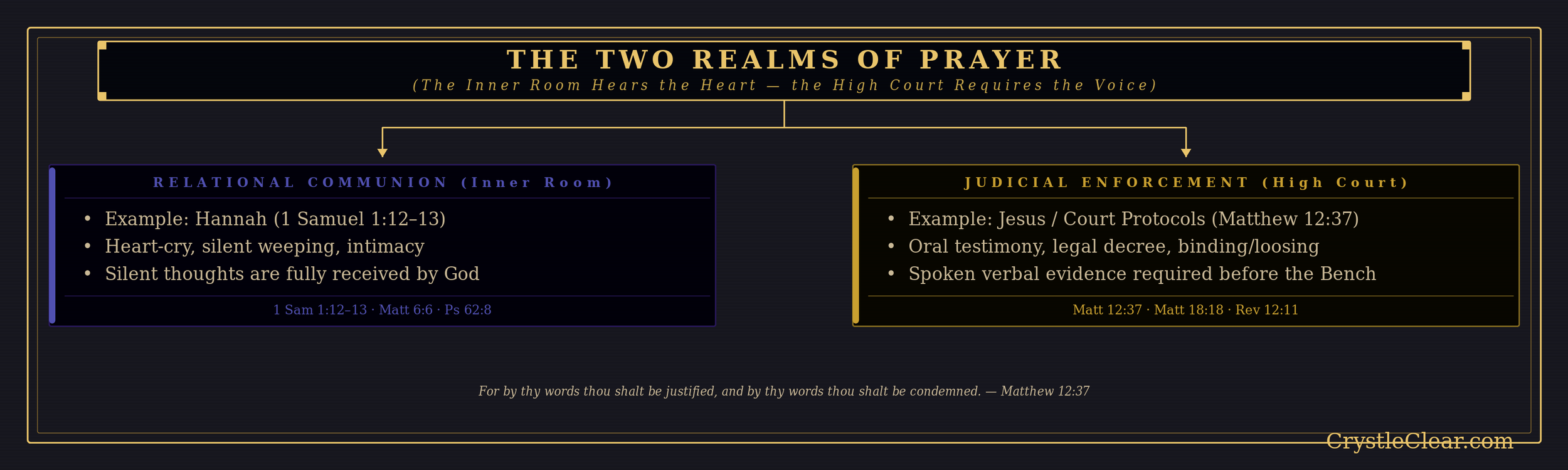
1. Relational Intimacy (The Hannah Model)
In 1 Samuel 1:12–13, Hannah prayed in deep anguish for a child: "She spoke in her heart; only her lips moved, but her voice was not heard." God heard her silent cry and granted her request.
Why was silent prayer effective for Hannah?
God is Omnipresent: God is everywhere present, surrounding us and dwelling inside us through the Holy Spirit. All things were created through and for Jesus (Colossians 1:16).
Father-Child Communion: When approaching God for comfort, personal grief, or intimate heart-fellowship, silent internal thoughts are fully understood by the Father.
2. Judicial Enforcement (Spiritual Warfare)
When shifting from relational communion into High-Court Legal Warfare—closing open dockets, revoking ancestral agreements, breaking curses, and evicting demonic squatters—silent prayer is legally insufficient.
Why?
The Enemy Is Not Omnipresent or Omniscient: Satan and his spirits cannot read your internal thoughts. They only know your position when you declare it out loud.
Courtroom Protocol Requires an Oral Record: In any court of law, a defense attorney cannot sit silently, think about evidence, and expect the case to be dismissed. Evidence must be spoken into the record!
Jesus explicitly tied legal acquittals and condemnations to spoken words in Matthew 12:36–37:
"For by your words you will be acquitted, and by your words you will be condemned."
Acquittal is a purely judicial verdict, and Jesus made it clear that oral speech is the required evidence before the Bench!
High-Court Operational Application
If you have been intimidated by religious pushback or told that legal prayer is extra-biblical, return to the foundational mechanics of Scripture:
Recognize Your Seated Authority: You are not an outsider trying to bribe a human court. Through the Blood of Jesus, you are operating under a sealed Covenant (Diathēkē) that gives you bold access to the Bench (Ephesians 2:6, Hebrews 4:16).
Cleanse Your Vessel Before Speaking: Ensure your heart is free from unrepented sin or bitterness so that your spoken testimony (Martyria) is clean and uncompromised.
Speak Your Testimony Out Loud: When closing open doors, repenting for ancestral trades, or enforcing bodily health, speak your renunciation and decrees out loud. Give your Advocate, Jesus Christ, the exact oral evidence He needs to declare: "CASE DISMISSED!"
Keywords: Courts of Heaven Diathēkē vs Martyria Legal Prayer Spiritual Jurisprudence Demonic CRM Monitoring Spirits Dominion Authority Psalm 103:20 Oral Testimony High Court Governance Kingdom Mechanics Crystle Vitari
#CourtsOfHeaven #KingdomMechanics #Diatheke #Martyria #LegalPrayer #SpiritualJurisprudence #DemonicCRM #DominionAuthority #HighCourtWarfare #CrystleClear #Deliverance #SpiritualGovernance #BiblicalExegesis
Questions and Topics Covered:
Why aren't the Courts of Heaven explicitly outlined as a step-by-step doctrine in the Book of Acts?
Isolating narrative history books like Acts ignores the broader judicial arc woven through Scripture. The Book of Acts is an operational field log, but it rests entirely on the legal infrastructure established from Job's heavenly council to Revelation's final judgment. Courtroom terms like Justification (Dikaiōsis), Advocate (Parakletos), and Accuser (Kategoros) define the entire New Covenant framework.
What is the legal difference between Biblical Testament (Diathēkē) and Testimony (Martyria)?
Diathēkē is the governing covenant contract sealed by the Blood of Jesus at the Cross—establishing your legal rights and inheritance. Martyria is the active, spoken witness evidence delivered verbally before the Bench in real-time. Revelation 12:11 establishes that while the Blood (Diathēkē) provides the legal contract, the Accuser is overcome when believers speak the word of their testimony (Martyria).
How do angels respond to God's Word spoken through human mouthpieces under Psalm 103:20?
Psalm 103:20 states that angels heed the "voice of His word." Because God legally deeded Earth dominion to humanity (Genesis 1:26–28), He chooses to voice His written decrees through authorized human mouthpieces. When believers speak God's Word out loud, it gives Heaven's rulings a legal human voice on Earth, authorizing angels to execute the decree.
If demons cannot read our internal thoughts, how do they track our fear and doubt?
Demonic entities track internal states through external micro-expressions: physical posture, vocal pitch, muscle tension, and eye movements. Additionally, familiar spirits study bloodline history and generational muscle memory to anticipate reactions, while monitoring spirits record observable behavioral patterns into dark dossiers.
What is a "Demonic CRM" and how do monitoring spirits use it?
Coming from a background in technology, I use "Demonic CRM" (Customer Relationship Management) to explain how Lucifer copied Heaven's ledger system (Daniel 7:10). Monitoring spirits compile dark database dossiers on bloodlines—recording unrepented ancestral trades, bitter agreements, and recurring sins—which the Accuser submits before Heaven's Bench to request affliction warrants.
Why did silent prayer work for Hannah in 1 Samuel 1, but legal prayer requires vocal declarations?
Hannah was engaging in relational communion with an omnipresent Father who dwells inside us and fully understands silent heart-cries. However, High-Court legal warfare involves confronting an enemy who is neither omnipresent nor omniscient. Judicial protocols require oral evidence to be entered into the record, and Jesus confirmed in Matthew 12:37 that legal acquittals are tied to spoken words.