

#61-The Subpoenaed Evidence: Three Empirical Pillars Proving the 164-Year Persian Suppression
While each article in this series functions as a standalone strategic briefing, the spiritual mechanics unpacked here operate on a progressive judicial order. To fully master the spiritual courtroom physics, legal definitions, and jurisdictional precedents that protect your life and bloodline, it is highly recommended to review these files in their original sequence, starting with Blog 1.Let’s establish an unbending baseline before we examine the courtroom data: If the Bible is true, then it MUST explain everything. It cannot be a textbook that beautifully unlocks half of reality while leaving the rest to guesswork, mystery, or theological blanks. A complete, divinely authored legal code does not leave gaps for the enemy to exploit. If scripture is the ultimate authority, it holds the complete systemic keys to mapping the unseen realm, explaining every anomaly, and establishing every jurisdictional rule of engagement without contradiction.The Accusation vs. The Evidentiary Standard
Throughout Blog 52 and Blog 60, I established a critical chronological fact: the modern Rabbinic calendar tracks the current year as AM 5786, creating an apparent 214-year gap until Year 6000 (6000 - 5786 = 214 years).
As I proved on the Legislative Bench, this gap is an artificial construct caused by a 164-year historical suppression embedded directly into the 2nd-century text Seder Olam Rabbah.

Skeptics and traditional critics often dismiss the 164 missing Persian years as a fringe theory or a speculative guess. It is neither.
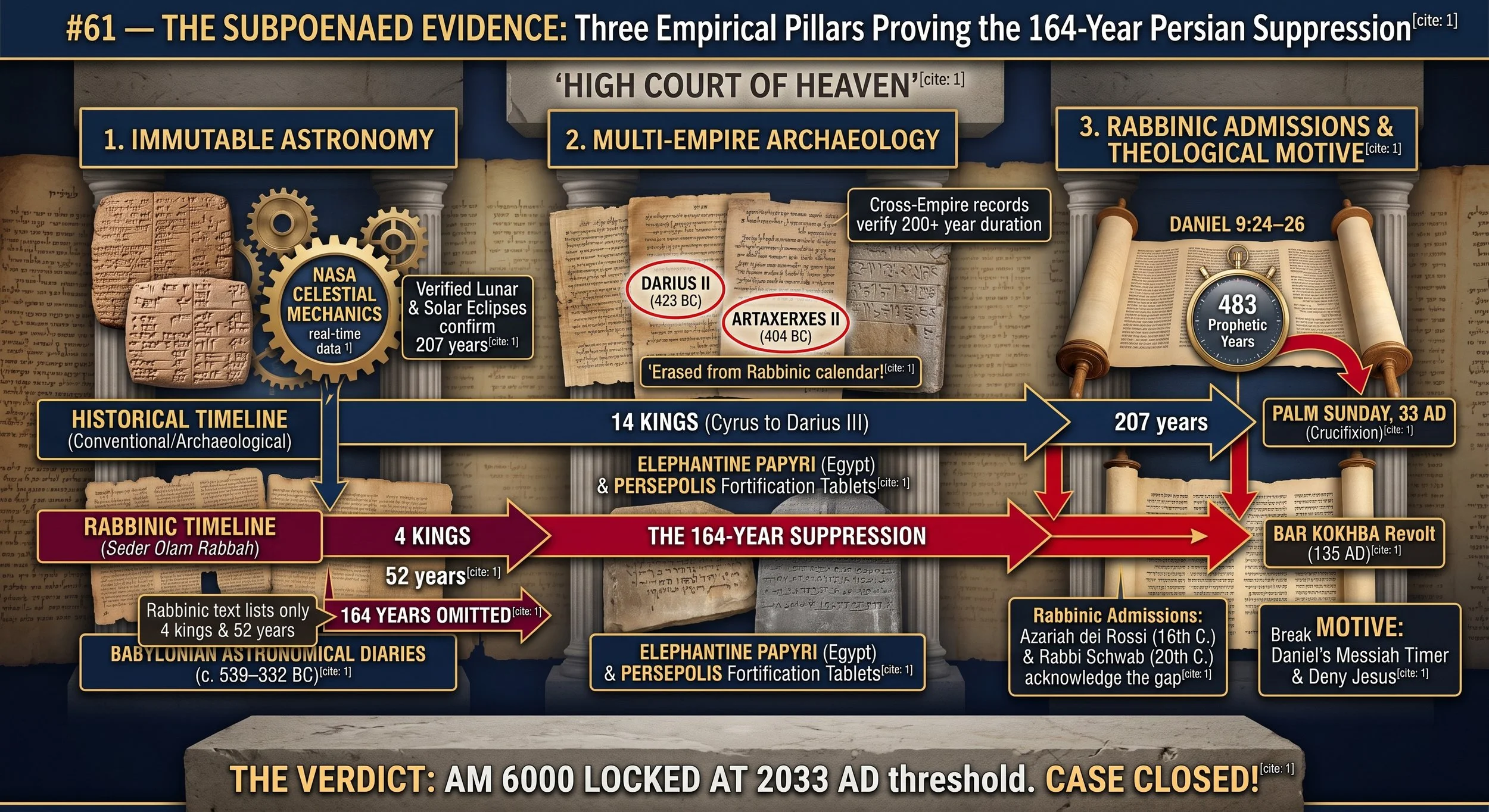
To prove beyond all legal doubt that 164 years were systematically removed from the traditional Hebrew timeline, we subpoena three independent, unassailable pillars of empirical evidence onto the High Court Bench: Immutable Astronomy, Multi-Empire Archaeology, and Rabbinic Textual Admissions
Pillar 1 — Immutable Astronomy & Cuneiform Solar Locks
The strongest evidence against the shortened Rabbinic timeline comes from the unbending laws of physical universe mechanics. Ancient civilizations recorded daily celestial events in real time on clay tablets, creating a cosmic time-stamp that modern science can independently verify.

1. The Babylonian Astronomical Diaries
Excavated across ancient Mesopotamia, thousands of contemporary cuneiform clay tablets record day-by-day positions of the moon, planets, solar eclipses, and lunar eclipses tied directly to the regnal years of Persian monarchs.
For example, tablet VAT 4956 explicitly documents planetary positions and eclipses during the 37th year of Nebuchadnezzar II. Similarly, tablets record eclipse cycles across the exact reigns of Cyrus the Great, Cambyses, Darius I, Xerxes, and Artaxerxes.
2. NASA Retro-Calculations
Modern astrophysicists use immutable celestial algorithms to run planetary mechanics backward. These equations prove that the lunar and solar eclipses logged on those cuneiform tablets occurred on exact calendar dates spanning a 207-year Persian Empire duration (from Cyrus in 539 BC to Darius III in 332 BC).
3. The Seder Olam Collapse
The Seder Olam Rabbah compresses this entire 207-year historical era down to just 52 years (claiming Persian rule over the Second Temple lasted only 34 years and listing only 4 Persian kings).
For the Rabbinic timeline to be correct, the orbits of the moon and planets would have had to halt for 164 years, or NASA's laws of physics would have to be entirely false! Empirical astronomy proves the 164-year suppression beyond a shadow of a doubt.
Pillar 2 — Multi-Empire Archaeological Inscriptions
The second pillar of evidence brings tens of thousands of contemporary primary documents into the courtroom, proving that 10 Persian kings omitted by the Rabbinic timeline were active historical figures.

The Elephantine Papyri: Discovered in Upper Egypt, these original 5th-century BC legal and religious documents were written by an ancient Jewish military colony. They explicitly date their contracts using the regnal years of Persian kings like Darius II and Artaxerxes II—rulers who do not exist on the shortened Seder Olam timeline!
The Persepolis Fortification Tablets: Tens of thousands of administrative tax receipts, royal decrees, and trade ledgers excavated in Iran document the long, unbroken royal successions of Achaemenid kings.
Classical Historians: Independent historians across ancient empires—including Herodotus, Thucydides, Xenophon, and Ptolemy's Canon—chronicle the full 200+ year Persian duration.
For the Rabbinic timeline to be historically valid, every contemporary Egyptian, Babylonian, Persian, and Greek scribe across two centuries would have had to participate in a massive, coordinated forgery—a physical impossibility.
Pillar 3 — Rabbinic Admissions & The Theological Motive
Why did 2nd-century Rabbinic authorities alter the chronological ledger?
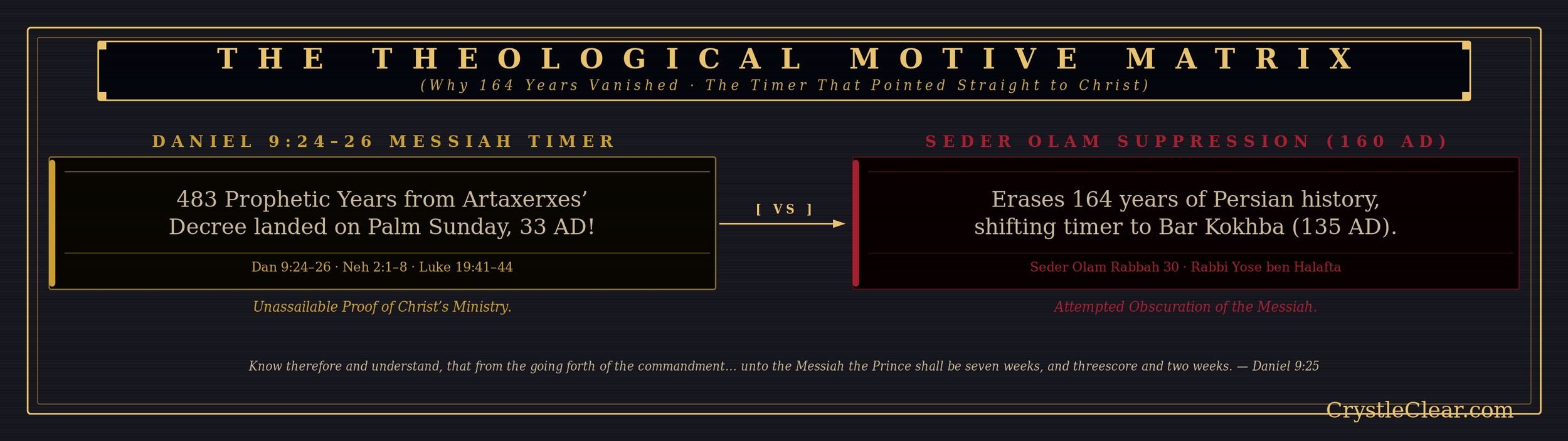
The answer exposes the ultimate high-court motive: breaking Daniel’s 483-year messianic timer to justify rejecting Jesus as the Son of God
1. The Daniel 9 Mathematical Trap
Daniel 9:24–26 predicted an exact 483-prophetic-year countdown (173,880 days) running from the decree to rebuild Jerusalem directly to the arrival and execution of the Messiah.
Calculated on the 360-day prophetic calendar, that countdown landed with microscopic precision on Palm Sunday, March 29, 33 AD—the exact day Jesus rode into Jerusalem on a donkey to be presented as King, right before He was crucified on Friday, April 3, 33 AD!
2. The Post-Temple Theological Crisis
Following the destruction of the Temple in 70 AD, Rabbinic leadership faced a catastrophic crisis: Daniel’s divine clock had expired precisely during the life, ministry, and execution of Jesus of Nazareth.
To break this mathematical proof—and to ensure their communities could continue to deny Jesus as the Son of God—2nd-century Rabbinic chronologists led by Rabbi Jose ben Halafta compiled the Seder Olam Rabbah. They intentionally compressed the Persian Empire era by 164 years, shifting Daniel's 483-year timer off the Cross of Christ and making it appear to point toward the failed rebellion of Simon Bar Kokhba in 132–135 AD instead!
3. Admissions by Prominent Jewish Scholars
This historical compression is not a hostile accusation; it is openly acknowledged by respected Jewish historians and scholars throughout history:
Azariah dei Rossi (16th Century): The renowned Italian-Jewish scholar was among the first prominent rabbis to publish a comprehensive critique of Seder Olam, proving that its Persian chronology contradicted historical and astronomical reality.
Rabbi Shimon Schwab (20th Century): The prominent Orthodox Jewish rabbi published a well-known paper acknowledging the 165-year discrepancy, proposing that the ancient Sages intentionally altered or concealed the timeline as a "divine secret" during the turbulent Roman era.
Isaac Abarbanel & Nachman Krochmal: Leading Jewish commentators throughout the centuries have acknowledged that the Seder Olam timeline condensed the Persian era.

The Verdict: Reclaiming AM 6000 at 2033 AD
When we bring the subpoenaed evidence onto the Judicial Bench, the veil is completely ripped away
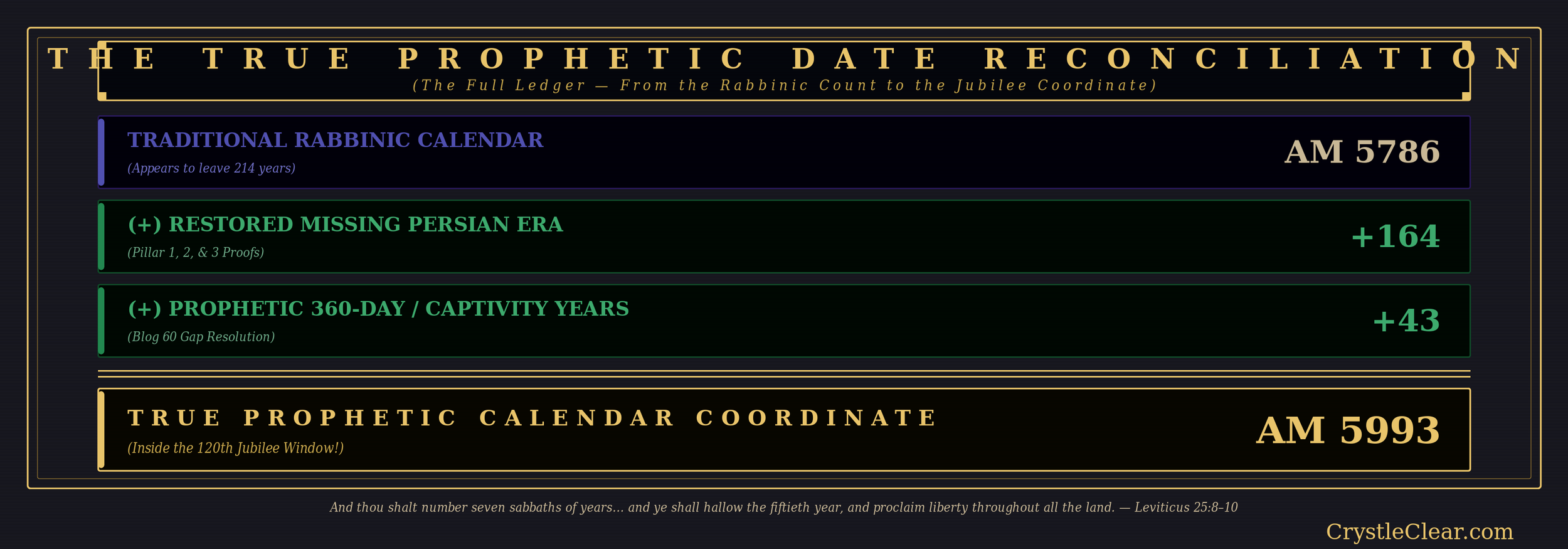
When you add the 164 missing Persian years to today's traditional date (AM 5786), and combine it with the 43 uncounted captivity/compressed prophetic years detailed in Blog 60, the math lands with absolute precision:
Today's true prophetic year sits in the AM 5990s—placing us directly in the closing moments of the 120th Jubilee (120 x 50 = 6,000 years) and locking Year 6000 directly onto the 2033 AD threshold!
The evidence is in. The timeline is sealed. Jesus Christ is the true Messiah, the Son of the Living God, and His Return is locked in absolute, mathematical perfection. Case Closed!
Keywords: blog 61 164 missing persian years seder olam rabbah daniel 9 prophecy 483 years palm sunday 33 AD cross babylonian astronomical diaries elephantine papyri azariah dei rossi rabbi shimon schwab am 6000 2033 threshold 120th jubilee case closed.
#SubpoenaedEvidence #164MissingYears #SederOlamUnmasked #Daniel9Prophecy #AM6000 #The2033Threshold #CaseClosed
Questions Answered in this Blog:
“How does astronomy prove that 164 years were omitted from the Persian era?”
Answer: Cuneiform tablets (like VAT 4956) record solar and lunar eclipses dated to Persian kings. NASA's retrograde calculations verify these eclipses occurred across a 207-year period (14 kings), whereas Seder Olam compresses this to 52 years (4 kings).
“What archaeological documents prove the long Persian timeline?”
Answer: The 5th-century BC Elephantine Papyri in Egypt explicitly name Persian kings like Darius II and Artaxerxes II, who are erased from the Rabbinic calendar. The Persepolis Fortification Tablets in Iran also log over two centuries of unbroken Persian trade and administrative receipts.
“Why did 2nd-century Rabbinic authorities shorten the timeline?”
Answer: To obscure Daniel 9's 483-prophetic-year timer, which landed precisely on Jesus Christ's entry into Jerusalem on Palm Sunday, 33 AD. By erasing 164 years, Seder Olam Rabbah shifted the timer off Christ to make it appear to point toward Bar Kokhba in 135 AD instead.
“Do Jewish scholars acknowledge the 165-year Persian discrepancy?”
Answer: Yes. Prominent Jewish historians and rabbis—such as Azariah dei Rossi (16th century), Isaac Abarbanel, and modern Orthodox Rabbi Shimon Schwab—have openly acknowledged or published papers on the missing ~165 Persian years in the Rabbinic calendar.