

#77 — The Metric Trap: Sovereign Encounters, Megachurch Expansion, and the Illusion of Divine Endorsement
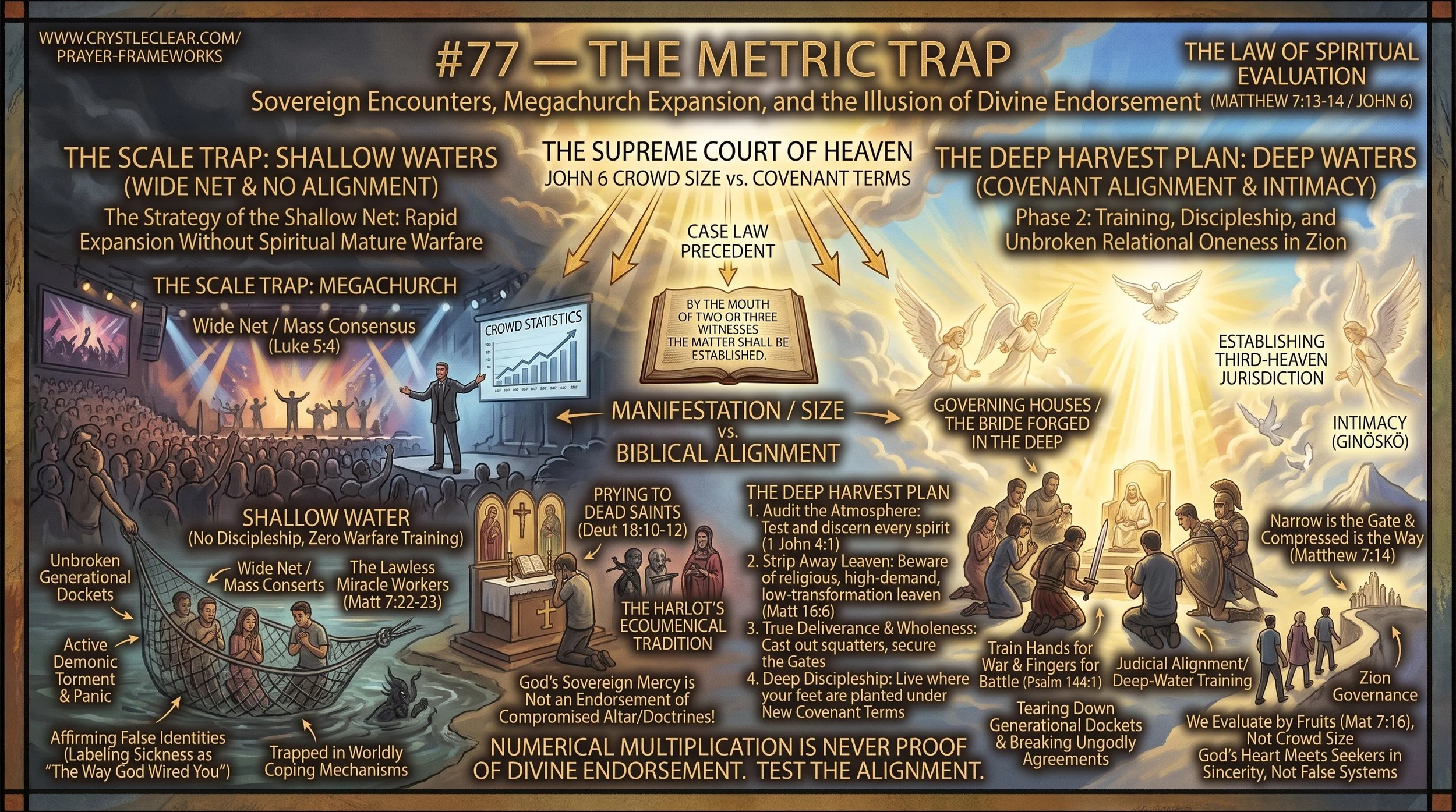
While each article in this series functions as a standalone strategic briefing, the spiritual mechanics unpacked here operate on a progressive judicial order. To fully master the spiritual courtroom physics, legal definitions, and jurisdictional precedents that protect your life and bloodline, it is highly recommended to review these files in their original sequence, starting with Blog 1.Let’s establish an unbending baseline before we examine the courtroom data: If the Bible is true, then it MUST explain everything. It cannot be a textbook that beautifully unlocks half of reality while leaving the rest to guesswork, mystery, or theological blanks. A complete, divinely authored legal code does not leave gaps for the enemy to exploit. If scripture is the ultimate authority, it holds the complete systemic keys to mapping the unseen realm, explaining every anomaly, and establishing every jurisdictional rule of engagement without contradiction.The Endorsement Fallacy: Manifestation vs. Alignment
A massive legal error occurs across modern denominations: a person weeps at an altar, shakes under spiritual power, receives an instantaneous physical touch, or speaks in tongues, and leadership immediately concludes:
"God moved mightily in our sanctuary; therefore, our theology, our traditions, and our leadership structure are certified by Heaven."
Pastors and priests frequently defend completely unbiblical practices not by opening the Scriptures, but by pointing to subjective phenomena:
"Someone was mysteriously healed here!"
"People fell out under the power during our service!"
"A parishioner had a vision during the liturgy!"
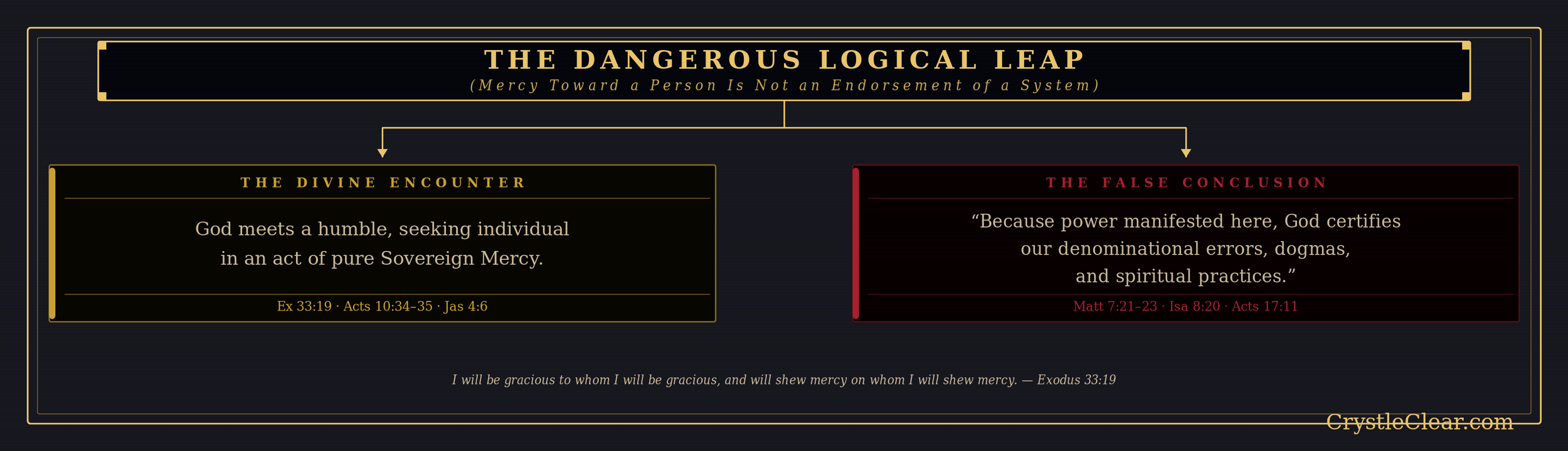
In spiritual jurisprudence, power is not an audit of truth. A manifestation of God's presence or the moving of the Holy Spirit on an individual vessel is not the asme as Heaven signing off on the doctrinal framework of the building they happen to be standing in.
The Two Fronts of the Endorsement Fallacy
A severe distortion of Kingdom jurisprudence occurs when leaders and believers use external phenomena rather than the written canon of Scripture to validate their operations:
Because God responds to the faith and desperation of His children, not the perfection of the building’s doctrinal bylaws.
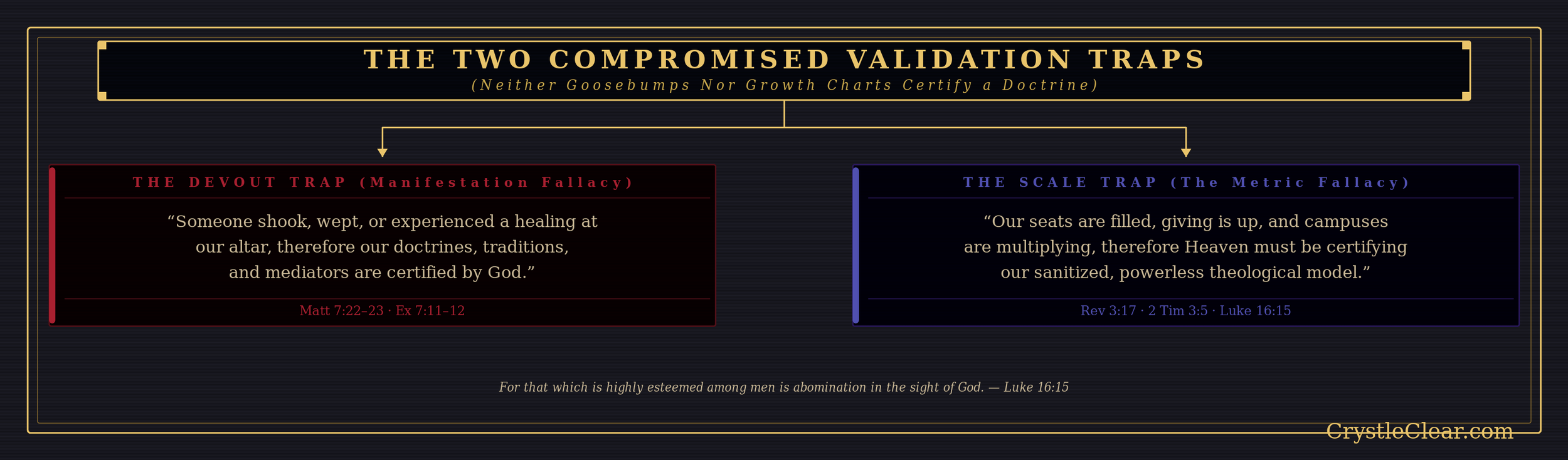
In divine law, neither emotional manifestations nor statistical foot traffic serve as evidence of doctrinal purity.
God often shows up at an altar simply because a desperate heart cried out in faith. Similarly, crowds routinely assemble around charismatic communicators, high-production music, and low-demand messages. In both cases, the presence of a human response does not mean Heaven has issued a final verdict of approval over the house.
In His boundless compassion, the Father bypasses the theological noise to deliver an individual child in need. But that preliminary touch is meant to draw the seeker deeper into truth—not to cement them into a counterfeit system.
The Strategy of the Shallow Net vs. The Full Harvest Plan
In Luke 5:4, Jesus instructed Peter: "Launch out into the deep and let down your nets for a catch."
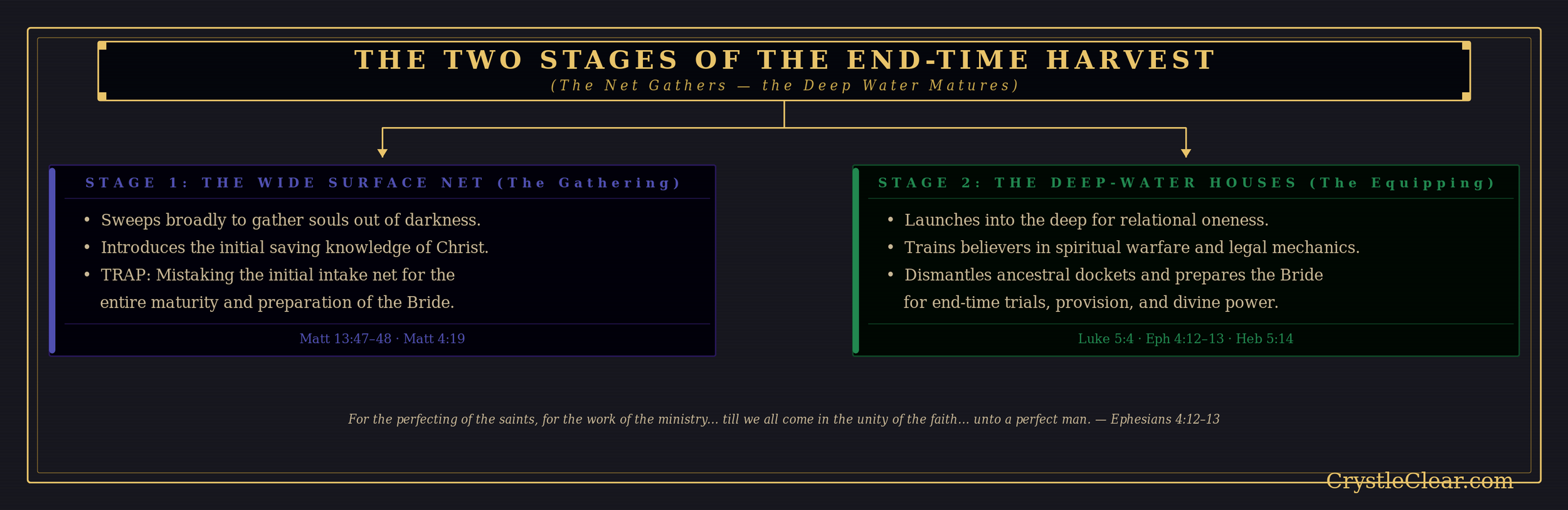
To properly understand modern expansionist churches, we must recognize God's macro-strategy without endorsing the blind spots of human leadership: Jesus does indeed use wide nets for the end-time harvest.
God in His wisdom uses high-capacity, seeker-oriented platforms to draw massive volumes of people out of the world and introduce them to the baseline reality of salvation in Christ. Casting a wide net is a genuine initial phase of Kingdom gathering.
The fatal error occurs when the pastors of these expansionist houses become blinded by their own attendance numbers, convincing themselves that their wide net is the entire counsel of God—the "be-all, end-all" purpose of the Church.
1. The Strategy of the Shallow Net
Because these wide-net platforms assume their initial intake is the complete package, they refuse to launch into the deep. They drag their nets strictly through shallow theological waters, producing severe deficiencies across the harvest:
Zero Warfare Training: Because spiritual dynamics and the unseen realm are avoided to keep services comfortable, new converts are left completely defenseless against demonic resistance, intrusive mental torment, and spiritual counter-attacks.
Unbroken Generational Dockets: Converts are taught moral platitudes and self-help tips, but are never guided through identifying ancestral iniquity, closing open doors, or revoking the enemy's legal leases before the Bench.
Affirming False Identities: Rather than enforcing complete deliverance through the Cross, shallow waters normalize secular labels. Believers are told that neurological afflictions, chronic anxiety, or addictive loops are "just how God wired you," or are instructed to "cope with grief" rather than stepping into supernatural liberation and wholeness.
2. The De-Supernaturalized Trap & The Rise of Deep-Water Houses
By sanitizing the supernatural power of the Gospel, wide-net platforms strip believers of the very tools required to endure the days ahead: supernatural provision, divine protection, and high-court governance.
When an infrequent healing does occur in their midst, leadership quickly labels it a "rare sovereign exception" and leverages it from the stage to validate their model. Meanwhile, the daily, normative signs of Mark 16:17—casting out demons, healing the sick, and walking in direct authority—are dismissed as fringe or unnecessary.
This is why the Lord is sovereignly raising up and commissioning distinct, deep-water churches and governing houses.
God is positioning mature, judicial communities designed specifically to receive those gathered by the wide nets and submerge them into the depths of His Word and Spirit. These deeper hubs exist to:
Strip away the religious leaven and psychological coping mechanisms.
Train the believer's hands for war and their fingers for battle (Psalm 144:1).
Bring the Bride into unbroken relational oneness and intimacy with Jesus, establishing a spotless people capable of standing in supernatural governance when external worldly systems shake.
The wide net gathers the catch; the deep waters forge the Bride. Leaders who mistake a crowded lobby for full spiritual maturity fail to see that Heaven is already directing the hungry out of the shallow shallows and into the depths of His presence.
John 6 and the Narrow Way: Crowd Size vs. Covenant Terms
The idea that numerical multiplication equals divine pleasure collapses under the ministry model of Jesus Christ.
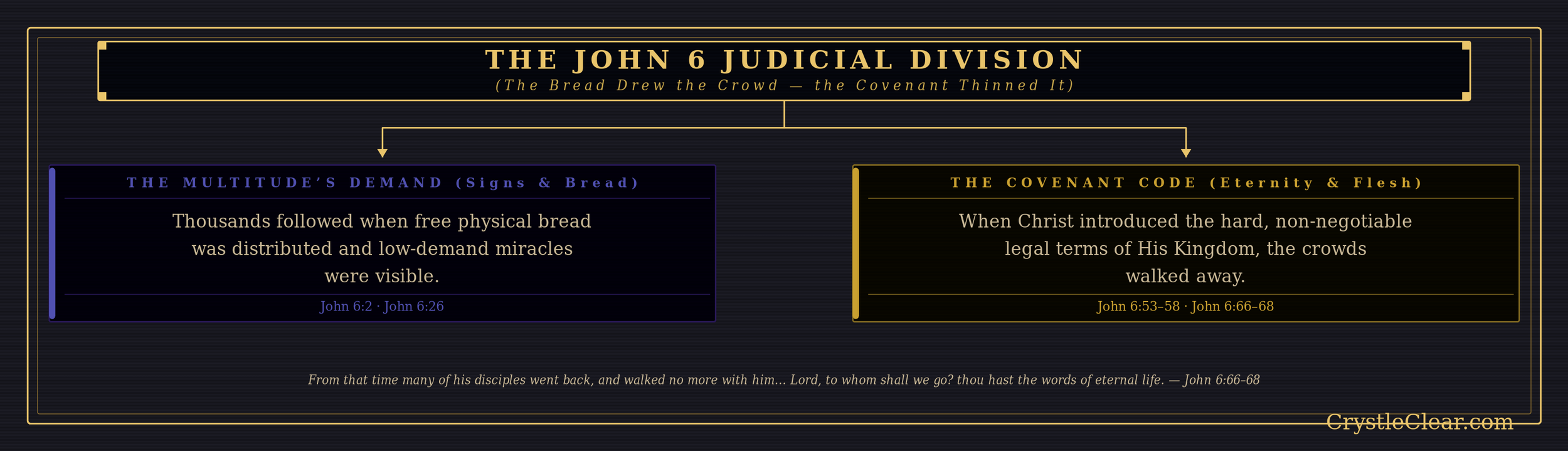
In John 6, thousands followed Jesus across the Sea of Galilee. Had modern church consultants evaluated the ministry of Jesus that afternoon, they would have rated it a monumental success.
Yet the moment Jesus stopped catering to the crowd's felt needs and proclaimed the unyielding, sacrificial terms of the New Covenant, the crowd abandoned Him. Jesus did not soften the message or form a focus group; He turned to the twelve and asked, "Do you also want to go away?" (John 6:67).
Jesus explicitly codified this reality in Matthew 7:13–14: the gate that leads to life is narrow and the way is compressed, and few find it, while the path of convenience and low accountability is broad and heavily populated. Mass consensus is never proof of righteousness.
Scriptural Precedents of Unendorsed Supernatural Operations
The Word of God provides clear warnings: God will move sovereignly, speak accurately, or permit supernatural transactions through individuals and platforms whose lifestyles and doctrines He formally rejects.
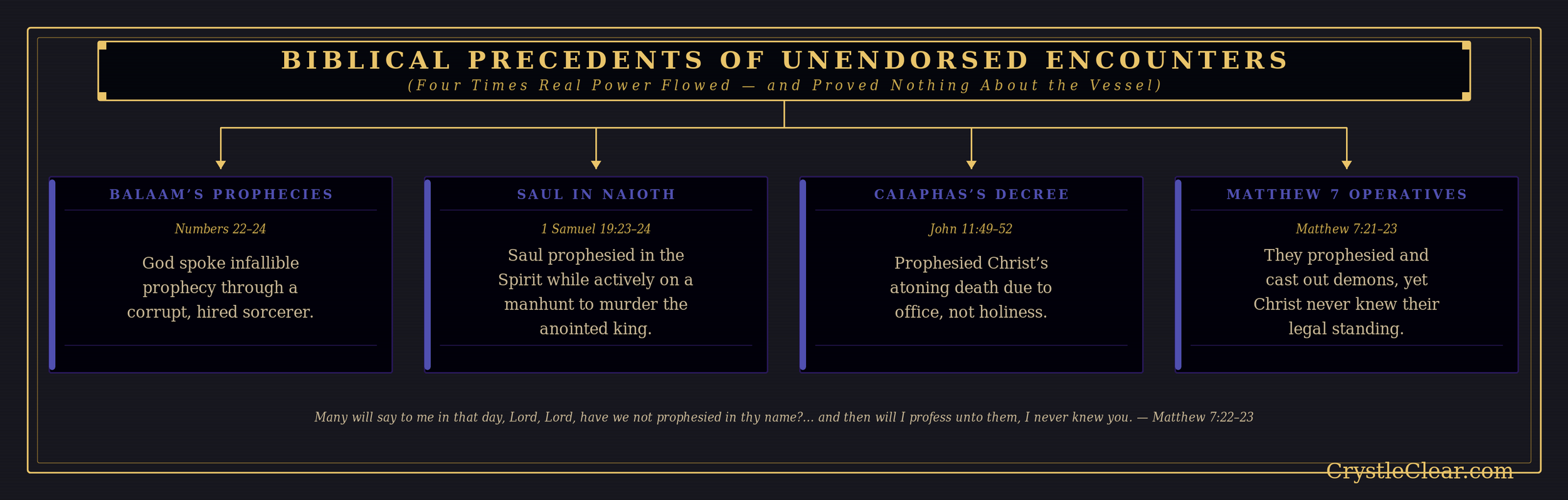
Scripture systematically proves that God will release accurate prophetic words, supernatural encounters, and delegated authority through vessels and environments He openly opposes:
1. Balaam and the Dumb Donkey (Numbers 22–24)
Balaam was a professional diviner hired by Balak to place an occult curse on Israel. God sovereignly took over Balaam's tongue, forcing him to issue some of the most exalted Messianic prophecies in the Torah.
Did the accuracy of the prophecy mean God approved of Balaam's trade? No. Scripture repeatedly condemns the "way of Balaam" and the "doctrine of Balaam" (2 Peter 2:15; Revelation 2:14).
2. King Saul Stripped Bare at Naioth (1 Samuel 19:23–24)
When Saul marched toward Naioth with blood in his eyes, intending to butcher David, the Spirit of God fell upon him. Saul stripped off his clothes and prophesied before Samuel all day and night.
Did Saul's prophetic ecstasy mean God endorsed his reign or excused his homicidal rebellion? No. Saul remained rejected by God as king, yet the atmosphere of Naioth overpowered his flesh.
3. Caiaphas the High Priest (John 11:49–52)
Caiaphas, the corrupt high priest scheming the judicial murder of Jesus, stood before the Sanhedrin and stated that it was expedient that one man should die for the people rather than the whole nation perish. Scripture explicitly notes that he did not speak this on his own initiative, but being high priest that year, he prophesied.
Did Heaven endorse the Sanhedrin's kangaroo court? No. The office carried a legal capacity that God spoke through, despite the wicked heart of the man holding it.
4. The Lawless Miracle Workers (Matthew 7:21–23)
Jesus issued the ultimate warning regarding spiritual gifts detached from judicial righteousness:
"Many will say to Me in that day, 'Lord, Lord, have we not prophesied in Your name, cast out demons in Your name, and done many wonders in Your name?' And then I will declare to them, 'I never knew you; depart from Me, you who practice lawlessness!'"
Signs, deliverances, and supernatural works can occur where true covenant intimacy (ginōskō) and obedience to God's legal code are completely absent!
Case Study: Corrupted Altars & Spiritual Proxy Agreements
Nowhere is the "Devout Trap" more apparent than in religious traditions that combine genuine devotion to Christ with deep, systematic covenants with darkness.
Consider the theological infrastructure of the Roman Catholic Church:
Sincere believers regularly encounter the mercy of Jesus at a Catholic altar, during the Eucharist, or while praying in a chapel.
Yet, within that identical ecclesiastical structure, the institution enforces:
Praying to Dead Saints: Directly violates the statutory prohibition against necromancy and consulting the dead (Deuteronomy 18:10–12).
Marian Co-Redemption: Assigning intercessory and mediatorial roles to Mary explicitly defies 1 Timothy 2:5, which establishes that there is only one Mediator between God and mankind: Jesus Christ.
Familiar Spirit Doorways: Praying to deceased believers opens an immediate legal doorway for deceptive familiar spirits to impersonate those saints, anchor religious deception, and introduce heavy spiritual burdens (2 Corinthians 11:14).
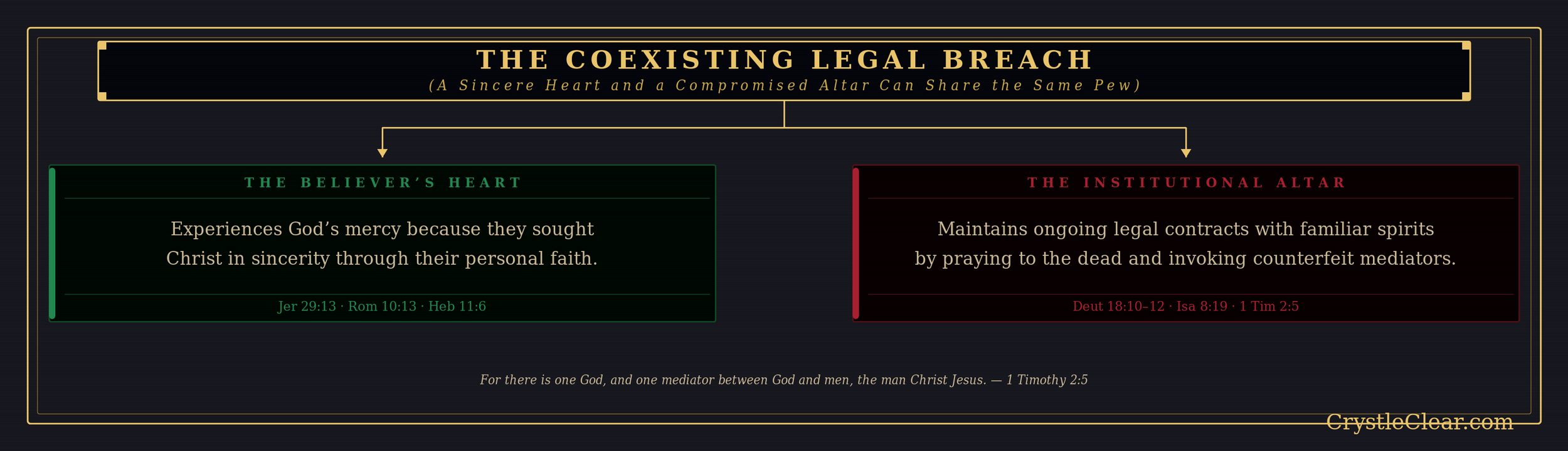
When a Catholic experiences a healing or an emotional breakthrough, pastors and priests point to it as "proof" that the Mass, the papacy, and praying the Rosary are endorsed by the Almighty.
In the Courtroom of Heaven, this is an illegal argument. God showed mercy to the crying person; He did not sign off on the altars of the Queen of Heaven.
The Believer’s Judicial Responsibility: Test and Discern
What is your responsibility if you received a genuine, life-altering touch of God inside a church or denomination that teaches doctrinal error or practices unbiblical spiritual models?
You are not permitted to remain spiritually passive, nor should you assume you are called to stay and "fix" an apostate corporate system on your own strength.
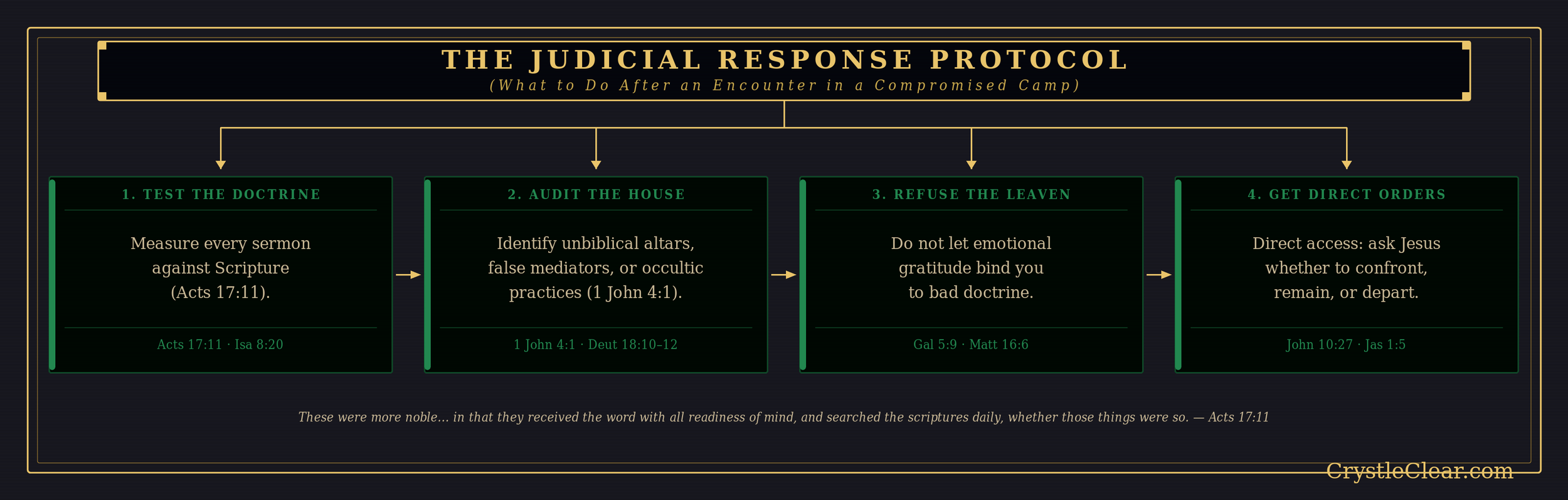
1. You Must Test the Spirits (1 John 4:1)
Believers are commanded to test every spirit and compare every teaching against the written Word of God. The Bereans in Acts 17:11 were called noble because they searched the Scriptures daily to verify whether Paul’s teachings aligned with the canon. If a pastor's sermon or church dogma directly contradicts Scripture, no amount of altar-call goosebumps can overturn that breach.
2. Guard Against Spiritual Leaven
Jesus warned: "Take heed and beware of the leaven of the Pharisees and the Sadducees" (Matthew 16:6). A small compromise in doctrine corrupts the entire vessel over time. Remaining seated under an altar that covenants with demonic mediators (praying to saints, syncretism, hyper-grace, or prosperity manipulation) exposes your soul and your children to the corporate dockets operating over that house.
3. Seek Direct Direction Before the Bench
You do not belong to a denomination, a charismatic personality, or a local priest. You belong to Jesus Christ.
Do not automatically assume you must leave overnight in bitter rebellion.
Do not automatically assume you are assigned to stay as a reformer.
Come directly before the Supreme Judge in secret:
"Lord, I thank You for Your mercy that met me at that altar. Now, reveal the purity of Your Word to me. Show me what in this house aligns with Your Law and what is unholy leaven. Give me clear judicial instructions: Am I to stand, speak, or walk away clean? in Jesus’ name I ask."
Keywords: The Scale Trap The Devout Trap Sovereign Encounters Systemic Endorsement Wide Net Shallow Waters Deep Water Churches Luke 5:4 End Time Harvest Relational Oneness Powerless Gospel De-Supernaturalized Church John 6 Discipleship Matthew 7:22-23 Catholic Altars Examined Praying To Saints Spiritual Warfare Training Generational Dockets Courts of Heaven CrystleClear
#KingdomMechanics #TheScaleTrap #TheDevoutTrap #SovereignMercy #DeepWaters #Luke54 #EndTimeHarvest #RelationalOneness #TestTheSpirits #BiblicalDiscernment #CourtsOfHeaven #SpiritualJurisprudence #ScriptureAlone #NoCompromise #DeliveranceMinistry #CrystleClear #BereanBeliever
Questions & Topics Answered in This Post
Does a massive, rapidly growing congregation mean God is blessing that church's doctrine?
No. As demonstrated in John 6 and Matthew 7:13–14, large crowds frequently gather around shallow teaching, free resources, and low-demand messages. While God uses wide-net churches to initially sweep souls out of darkness, rapid metric growth is not a divine certificate of doctrinal purity. Kingdom alignment is measured solely by faithfulness to the written Word of God, covenant obedience, and mature discipleship.
What is the true purpose and limitation of modern "wide-net" churches?
Wide-net churches serve an initial gathering function for the end-time harvest, pulling large volumes of people toward the basic saving knowledge of Christ. However, the trap occurs when leadership views this wide net as the final, complete counsel of God. Because they stay in shallow waters, they leave converts untrained in spiritual warfare, trapped under ancestral legal dockets, and reliant on worldly coping mechanisms instead of true supernatural deliverance.
Why is God raising up distinct "deep-water" churches alongside wide-net ministries?
While the wide net gathers the catch, it does not forge the Bride. The Lord is establishing deep-water houses (Luke 5:4) to take believers beyond surface conversion into deep relational oneness with Jesus. These governing communities train believers in spiritual jurisprudence, dismantle generational dockets, restore normative signs and deliverance (Mark 16:17), and prepare the Church with supernatural protection and provision for the end times.
If someone receives a genuine miracle at an unbiblical or Catholic altar, does that mean God endorses the institution?
No. God responds to the sincere, desperate faith of an individual crying out to Him under Sovereign Mercy. An act of divine compassion toward a person is never a legal certification of unbiblical doctrines, such as praying to the dead (Deuteronomy 18:10–12) or exalting Mary as an equal mediator alongside Christ (1 Timothy 2:5).
Why do some growing platforms treat healing and deliverance as "rare exceptions"?
De-supernaturalizing the Gospel keeps church environments comfortable and culturally palatable, avoiding the offense of the unseen realm. When an occasional healing does take place, leadership often claims credit to validate their platform while dismissing regular biblical signs and deliverance as extreme or unnecessary—stripping the flock of practical authority before the Bench.