

#66 — The Mark Isn’t a Day: Debunking Calendar Legalism and Restoring Everyday Worship
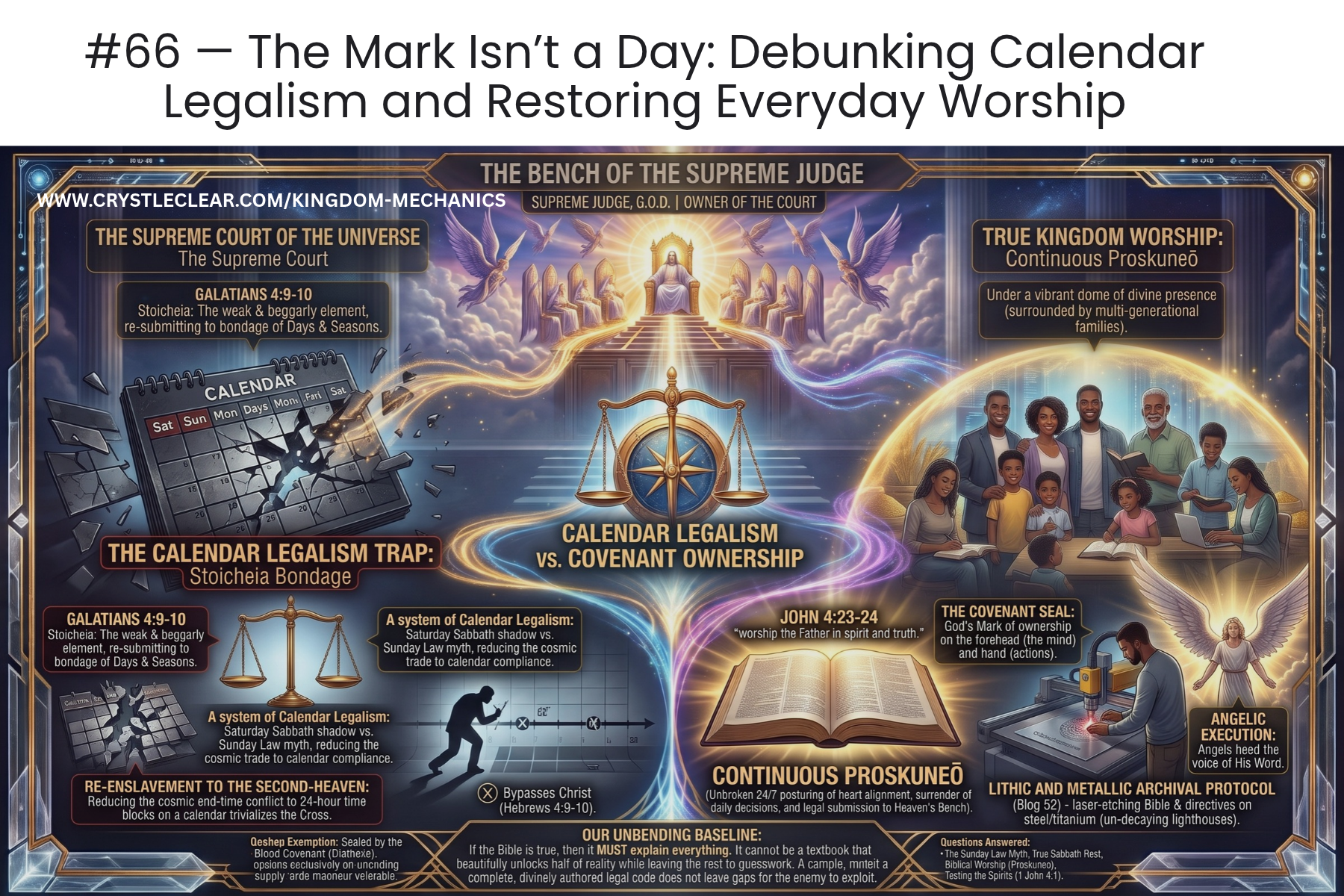
While each article in this series functions as a standalone strategic briefing, the spiritual mechanics unpacked here operate on a progressive judicial order. To fully master the spiritual courtroom physics, legal definitions, and jurisdictional precedents that protect your life and bloodline, it is highly recommended to review these files in their original sequence, starting with Blog 1.Let’s establish an unbending baseline before we examine the courtroom data: If the Bible is true, then it MUST explain everything. It cannot be a textbook that beautifully unlocks half of reality while leaving the rest to guesswork, mystery, or theological blanks. A complete, divinely authored legal code does not leave gaps for the enemy to exploit. If scripture is the ultimate authority, it holds the complete systemic keys to mapping the unseen realm, explaining every anomaly, and establishing every jurisdictional rule of engagement without contradiction.Historical Roots: How and Why Churches Adopted Calendar Legalism
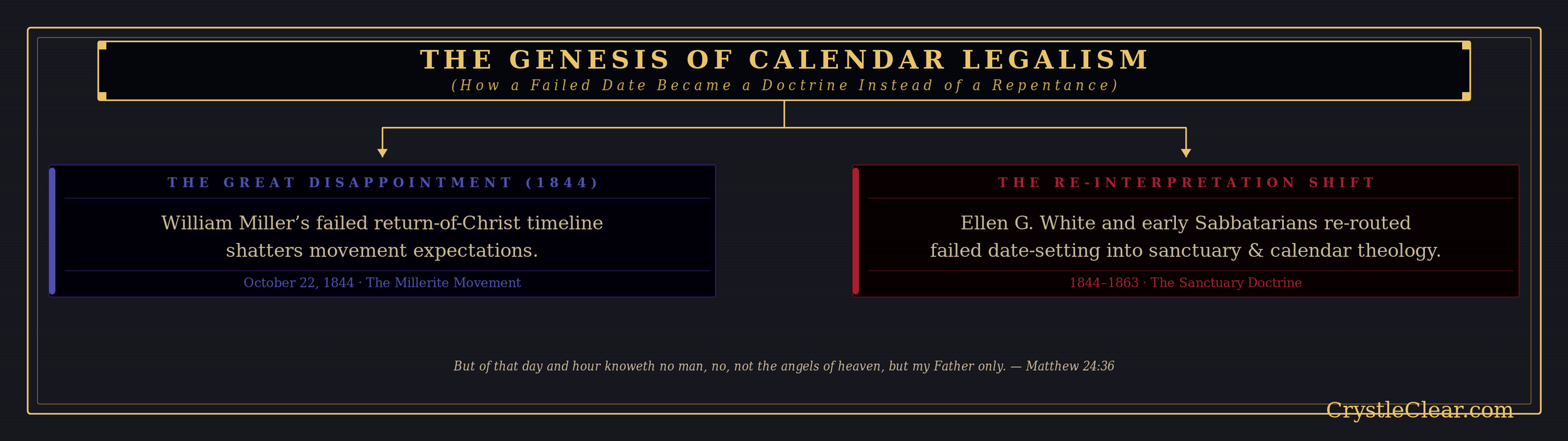
To dismantle a counterfeit doctrine effectively, we must trace its origin story. The belief that worshipping on Sunday constitutes taking the Mark of the Beast—and that seventh-day Sabbath keeping is the ultimate seal of God—did not emerge from first-century apostolic teaching. It was birthed during the intense apocalyptic fervor of nineteenth-century America.
1. The 1844 "Great Disappointment" Trauma
In the early 1840s, the Millerite movement predicted that Jesus Christ would return physically on October 22, 1844. When the day passed and nothing visible happened, tens of thousands of believers suffered severe spiritual trauma—an event recorded in history as the Great Disappointment.
To explain why Christ had not returned, a splinter group led by Ellen G. White and early Seventh-day Adventist founders reinterpreted the timeline. They claimed that on October 22, 1844, Christ had not descended to Earth, but had instead entered the "Most Holy Place" of the heavenly sanctuary to begin an "investigative judgment."
2. Elevating the Sabbath to the Ultimate End-Time Test
To establish a distinct identity for this surviving movement, early Adventist visionaries elevated the seventh-day Sabbath from an Old Covenant ceremonial rest into the pivotal, final-generation test of salvation.
They taught that in the end times, the papacy and secular governments would unite to enforce a national and global "Sunday Law." Under this framework, anyone attending church on Sunday would consciously or unconsciously receive the Mark of the Beast, while those holding fast to Saturday worship would receive the Seal of God.
This was not grounded in original Biblical Greek exegesis; it was a retroactive theological defense mechanism built to justify a failed end-time prediction.
Institutional Anchors: Why Sabbatarian Systems Stand By It Today
Why do denominations and independent Sabbatarian groups hold so fiercely to this doctrine today, even when presented with clear New Covenant Scripture?
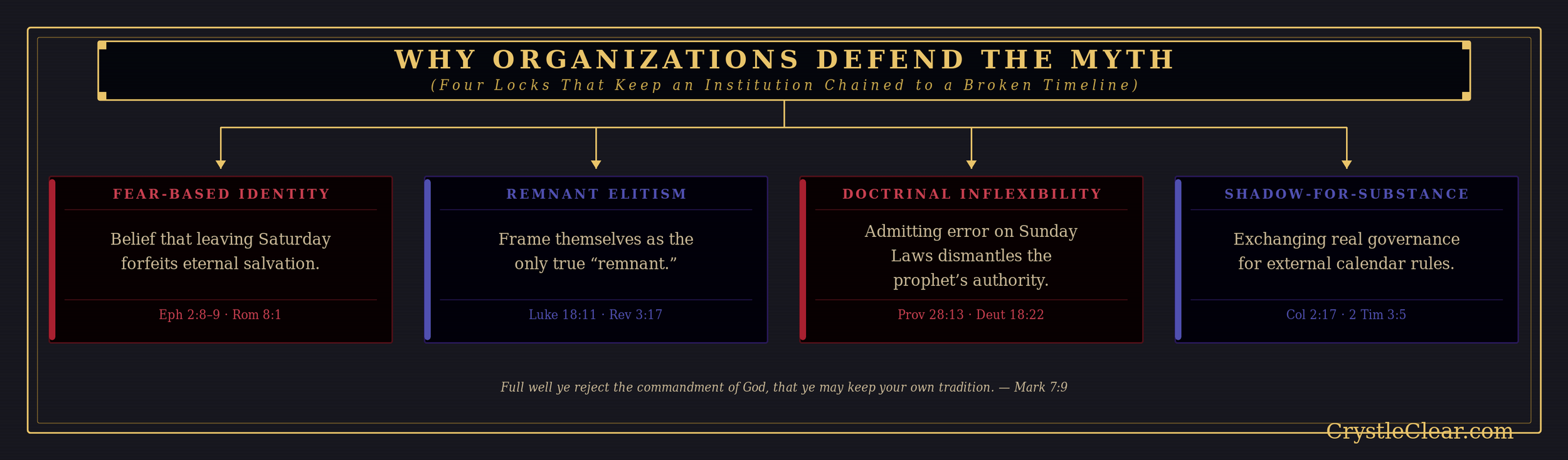
Fear-Based Retention: When a church conditions its members to believe that stepping into a Sunday church service risks taking the Mark of the Beast, it creates an intense, phobia-driven psychological lock. Members stay not always out of love for Christ, but out of existential terror of being lost on a technicality.
The "Remnant" Superiority Complex: Framing calendar observance as the dividing line of the end times grants adherents an immediate sense of elite spiritual status. It allows believers to feel superior to millions of Spirit-filled Christians simply because they observe a different 24-hour block of time.
Inability to Recant Without Collapsing the System: For organizations built on the claimed infallibility of a nineteenth-century founder or prophet, admitting that the "Sunday Law" doctrine is unscriptural would shatter the foundational credibility of their entire denomination. Thus, the system is forced to defend the myth at all costs.
Shadow-for-Substance Trade: It is much easier for the human flesh to keep a calendar day, refrain from work for 24 hours, and follow dietary rules than it is to execute deep, internal death to self, High-Court legal clearance, and 24/7 spiritual governance. Satan gladly encourages calendar legalism because it gives people a false sense of righteousness while leaving their internal open doors untouched.
Deconstructing the Myth: Why the Mark Is Not a Calendar Day
For over a century, a segment of the Church has promoted a fear-based doctrine claiming that the Mark of the Beast will be enforced as a universal "Sunday Law"—a mandatory decree forcing humanity to worship on the first day of the week rather than the seventh-day Sabbath. Under this system of calendar legalism, worshipping on Sunday is framed as taking the Mark, while observing Saturday is presented as the ultimate seal of salvation.
This teaching fails to grasp basic High-Court Covenant Jurisprudence.
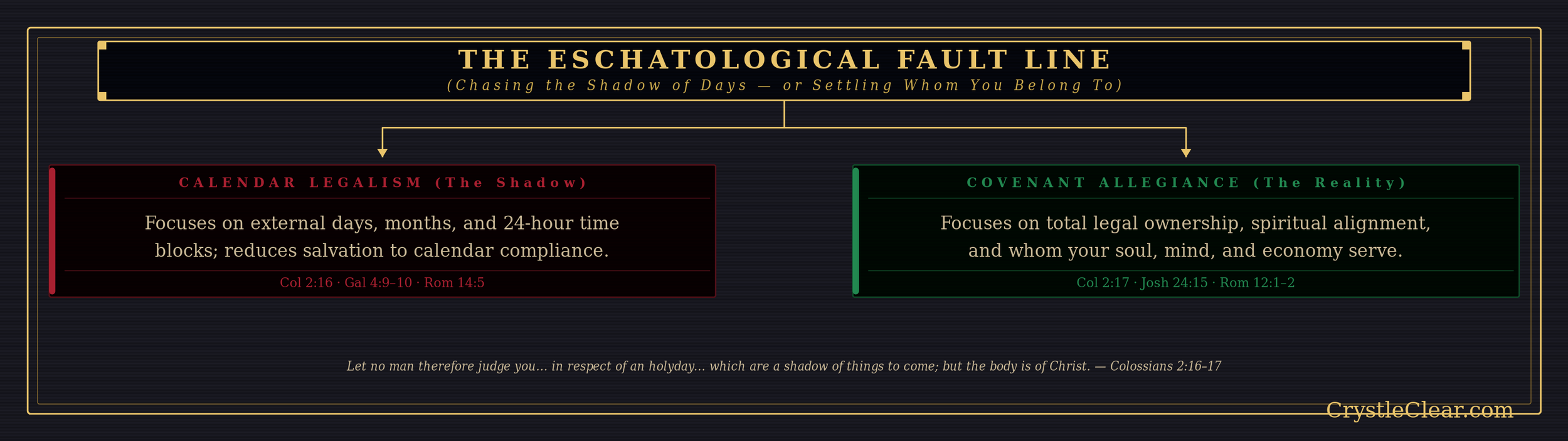
Satan does not care what day of the week you mark on a calendar. The adversary is a legalist who seeks total covenant ownership of human vessels. Reducing the cosmic end-time conflict between the Kingdom of God and the Beast system to a disagreement over Saturday versus Sunday completely trivializes the Cross and replaces spiritual discernment with OT ceremonial shadows.
The Scriptural Blueprint: Charagma as a Seal of Ownership
To understand why the Mark cannot be a day, we must return to the Biblical Greek definition of the Mark in Revelation 13:16–17.
As unpacked in Blog #20, the word used for Mark is Charagma:
Historical Context: In the ancient Roman world, a charagma was an official imperial stamp, seal, or brand placed on commercial documents, imperial coins, and livestock. It was a visible proof of mastery, tax compliance, and legal ownership.
Spiritual Mechanics: The Mark of the Beast is an intentional covenant trade where an individual consciously pledges allegiance to the Beast system in exchange for economic survival, access to the marketplace, and second-heaven protection.
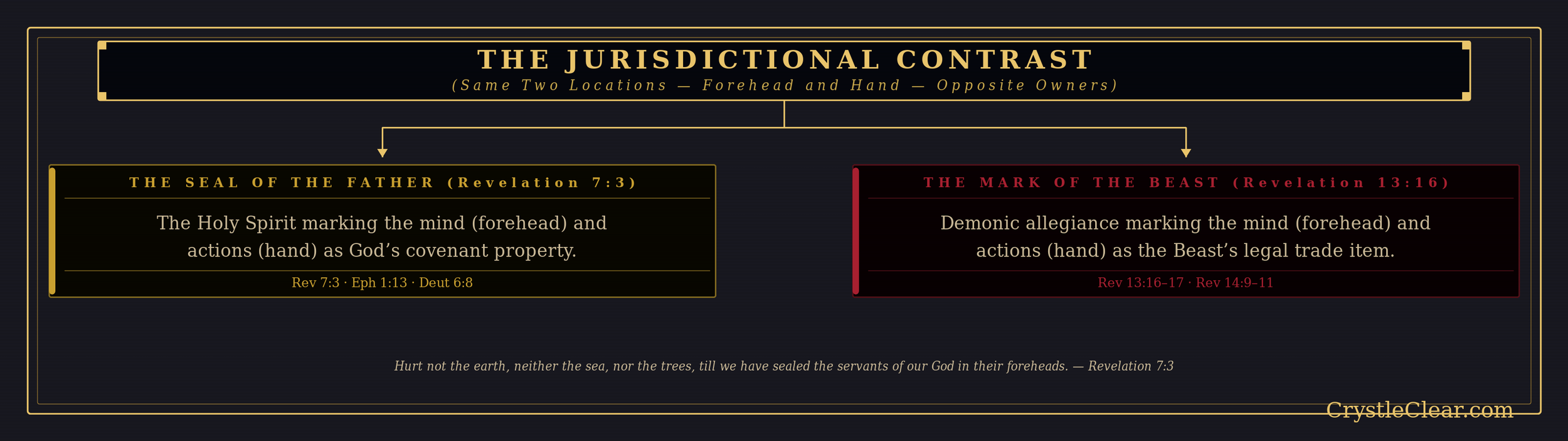
Notice the direct parallel: God seals His Bride in her forehead (her mind, allegiance, and spiritual alignment). The Beast counterfeits this by marking the forehead and hand (mind and actions). Neither seal is a 24-hour time block on a calendar! Both are legal badges of spiritual ownership.
The Galatians 4 Trap: Re-Enslavement to Stoicheia
When believers reduce true worship to calendar observance, they fall into the exact trap Paul warned the church of Galatia about.
In Galatians 4:9–10, Paul writes:
"But now after you have known God, or rather are known by God, how is it that you turn again to the weak and beggarly elements, to which you desire again to be in bondage? You observe days and months and seasons and years."
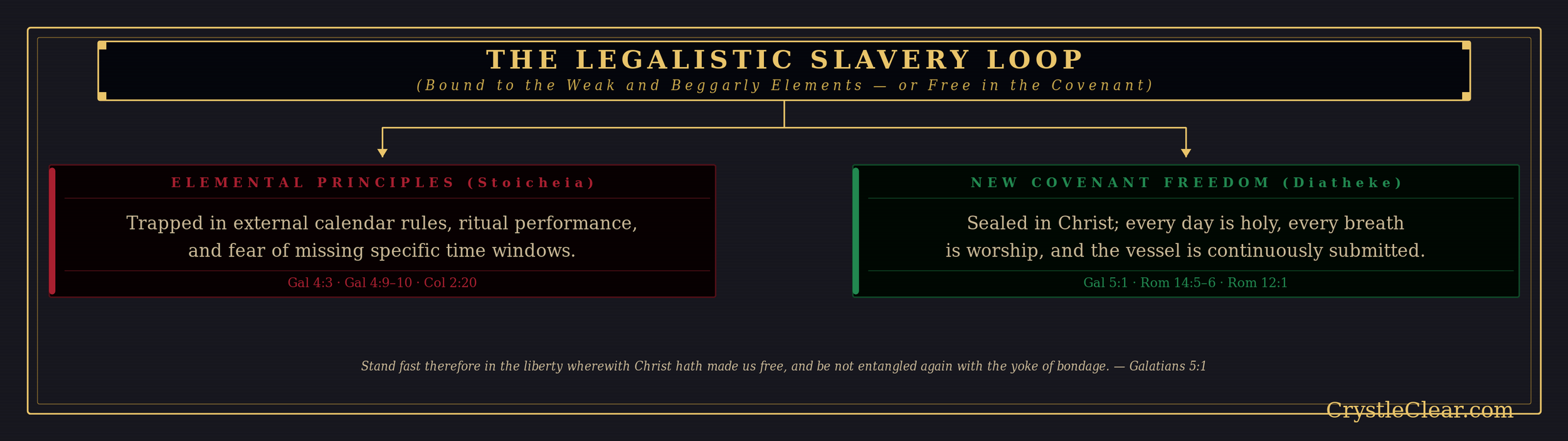
When you believe that your legal standing before God depends on observing a specific day, you step out of the New Covenant (Diathēkē) and re-submit your neck to the stoicheia—the basic second-heaven principles of the world.
Jesus declared in Mark 2:27: "The Sabbath was made for man, and not man for the Sabbath." The Sabbath was a prophetic shadow pointing to the person of Jesus Christ, who is our eternal, continuous Sabbath rest (Hebrews 4:9–10). In Christ, we do not enter rest one day a week; we reside in His rest continuously!
True Kingdom Worship: Continuous Proskuneō
If worship is not a day, what is it?
In John 4:21–24, Jesus shattered calendar and geographical legalism during His conversation with the Samaritan woman at the well:
"Woman, believe Me, the hour is coming when you will neither on this mountain, nor in Jerusalem, worship the Father... But the hour is coming, and now is, when the true worshipers will worship the Father in spirit and truth."
The Greek word Jesus used for worship is Proskuneō:
Literal Meaning: To kiss the hand, to bow down in complete prostration, or to yield absolute reverence and obedience to a King.
High-Court Reality: Proskuneō is an unbroken posture of submission before the Bench. It is not a 2-hour musical service on Sunday, nor is it sitting in a building on Saturday.
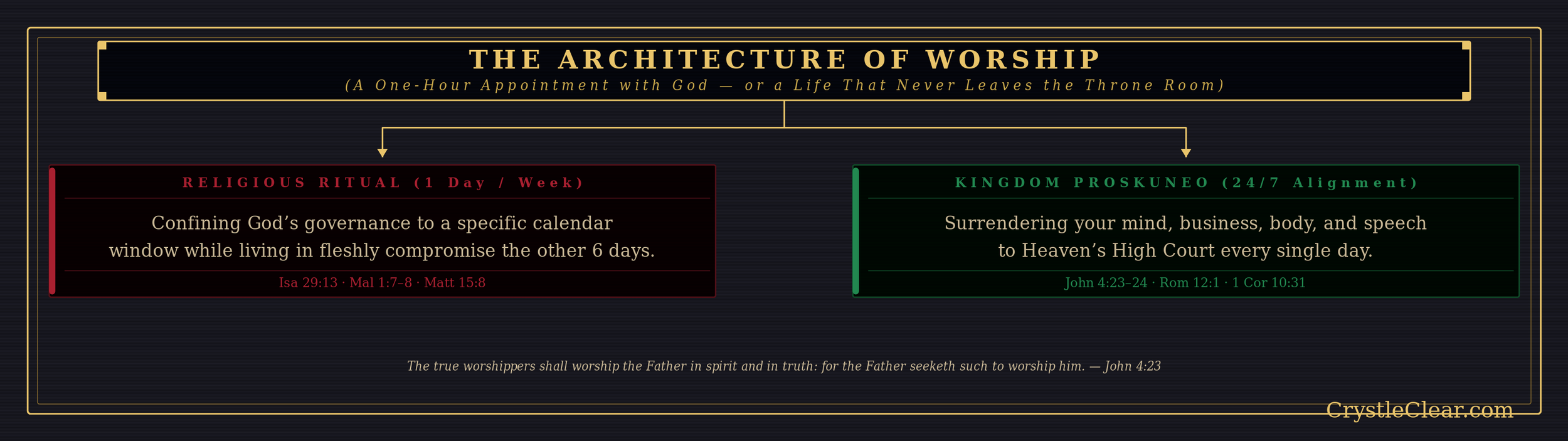
True Kingdom worship means your business operations, your mouth, your eye-gates, your marriage, and your finances are legally yielded to Jesus 24 hours a day, 7 days a week. When your life is an unbroken proskuneō, no second-heaven calendar system can divert your allegiance!
High-Court Operational Application
To dismantle calendar legalism and step into continuous High-Court governance:
Repent of Calendar Fear: Renounce all fear-based doctrines that claim worshipping on Sunday or any other day automatically subjects you to the Mark of the Beast.
Break Free from Stoicheia: Refuse to let anyone judge you regarding days, new moons, or Sabbath shadows (Colossians 2:16–17). Stand fast in the liberty of Christ.
Elevate Your Worship to 24/7 Governance: Recognize that true worship (Proskuneō) is the legal surrender of your daily decisions, thoughts, and actions before the Supreme Judge.
Anchor Your Allegiance in the Blood: Ensure your covenant deed (Diathēkē) is sealed exclusively in Jesus Christ. When your mind and actions are marked by the Holy Spirit, the enemy’s counterfeit charagma has zero legal access to your vessel!
Keywords: Mark of the Beast Charagma Sunday Law Myth Calendar Legalism Galatians 4 Stoicheia Proskuneo True Worship Sabbath Rest in Christ Courts of Heaven Kingdom Mechanics
#MarkOfTheBeast #CalendarLegalism #Proskuneo #KingdomMechanics #SabbathRest #Charagma #CourtsOfHeaven #CrystleClear #SpiritualJurisprudence #Deliverance #HighCourtGovernance
Questions & Topics Answered in This Post
Is the Mark of the Beast a mandatory "Sunday Law" enforcing worship on a specific calendar day?
No. The "Sunday Law" doctrine is a legalistic myth that reduces a cosmic covenant trade to calendar compliance. The Mark of the Beast (Charagma) is an intentional legal seal of ownership, allegiance, and spiritual submission—not a day of the week.
What does the Greek word Charagma reveal about the true nature of the Mark?
In ancient Rome, a charagma was an official stamp or brand proving imperial ownership, tax compliance, and legal mastery. In end-times jurisprudence, the Mark represents a conscious covenant trade where a person yields their mind (forehead) and actions (hand) to the Beast system for economic access.
How does Paul address calendar legalism in Galatians 4:9–10?
Paul explicitly warns that observing days, months, seasons, and years as a requirement for righteousness re-enslaves believers to stoicheia (second-heaven elemental principles). It exchanges New Covenant freedom in Christ for legalistic bondage.
How did Jesus redefine Sabbath rest and worship in the New Covenant?
Jesus declared that He is the Lord of the Sabbath (Mark 2:28) and that true worshipers worship the Father in spirit and in truth rather than at specific physical locations or times (John 4:21–24). Jesus is our true Sabbath rest (Hebrews 4:9–10); in Him, rest and alignment are continuous, daily realities.
What is the Biblical definition of true Kingdom worship (Proskuneō)?
Proskuneō means total prostration and yielding of authority before a King. True Kingdom worship is not a weekly church service or calendar ritual, but an unbroken, 24/7 posture of heart alignment, moral purity, and legal submission to Heaven’s Bench.