

#17 - The Canonical Audit: The Rules of Spiritual Evidence
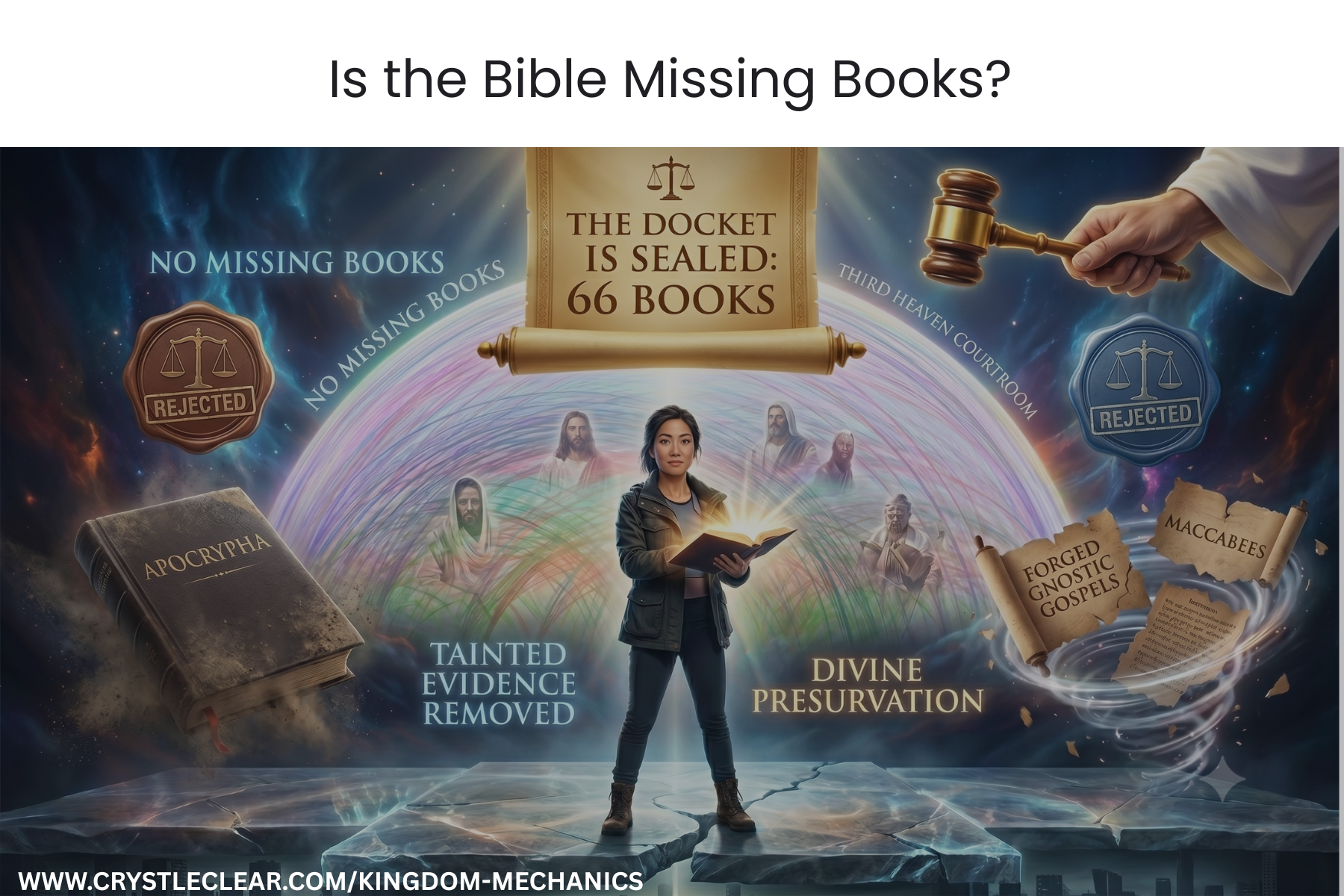
LAST UPDATED JUNE 15, 2026 While each article in this series functions as a standalone strategic briefing, the spiritual mechanics unpacked here operate on a progressive judicial order. To fully master the spiritual courtroom physics, legal definitions, and jurisdictional precedents that protect your life and bloodline, it is highly recommended to review these files in their original sequence, starting with Blog 1.Let’s establish an unbending baseline before we examine the courtroom data: If the Bible is true, then it MUST explain everything. It cannot be a textbook that beautifully unlocks half of reality while leaving the rest to guesswork, mystery, or theological blanks. A complete, divinely authored legal code does not leave gaps for the enemy to exploit. If scripture is the ultimate authority, it holds the complete systemic keys to mapping the unseen realm, explaining every anomaly, and establishing every jurisdictional rule of engagement without contradiction.Is the Bible Missing Books?
In any terrestrial courtroom, a trial cannot begin until the evidence is formally admitted into the record. If a piece of evidence is forged, tampered with, or lacks a verifiable chain of custody, the defense object, and the judge instantly throws it out. The spiritual realm operates under the exact same strict parameters.
The enemy's primary strategy to weaken your legal stance at the bench is to make you doubt your ultimate legal manual: the Bible. He whispers through New Age channels, secular media, and ancient religious traditions that the Bible is a fractured, incomplete book. They claim that "men voted on what to include," that critical "lost books" were omitted, or that ancient religious institutions hold the exclusive right to add extra material to the record.
It is time to conduct a forensic canonical audit. When you examine the data, you discover that the Bible is not a random collection of human paperwork—it is a legally airtight, self-authenticating divine dossier that is completely whole, perfectly preserved, and missing absolutely nothing.
The Custody of the Record: The Old Testament Covenant
The claim that books were "lost" or left out of the Old Testament completely ignores the strict, divine chain of custody established by God Himself.
God did not hand His words to political empires; He legally assigned the preservation of the Old Testament to a specific ethnic and priestly line.
As the Apostle Paul notes in Romans 3:1-2: "What advantage then hath the Jew? ... Chiefly, because that unto them were committed the oracles of God." The Jewish people maintained a hyper-vigilant, mathematically precise system for copying and preserving the Hebrew Scriptures. Every letter, word, and paragraph was counted. If a single mistake was found on a scroll, the entire scroll was destroyed. By the time Jesus walked the Earth in the first century, the Hebrew Canon—known as the Tanakh (the Law, the Prophets, and the Writings)—was firmly closed. It consisted of the exact same 39 books we find in our Bibles today.
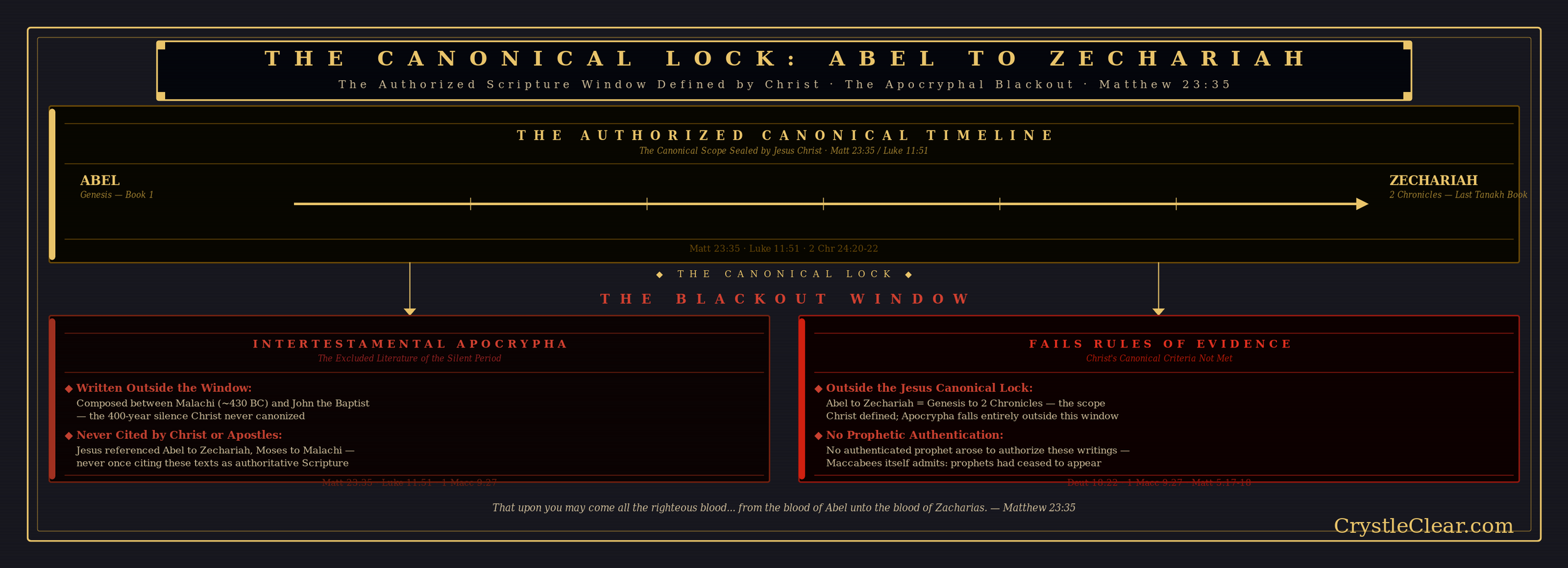
To completely overrule the accusation of "removed books" on the courtroom floor, we look directly at the supreme judicial signature Jesus Christ placed exclusively on the Hebrew Canon. In Luke 11:51 (and Matthew 23:35), Jesus delivers a devastating courtroom indictment against the religious matrix, holding them liable for the blood of all the prophets: "...from the blood of Abel to the blood of Zechariah who perished between the altar and the temple."
Look at the mathematical and chronological genius of this decree. In our modern Bibles, Malachi is the last book of the Old Testament. But in the original Hebrew arrangement of the scriptures authorized by Jesus, the books were ordered differently:
Genesis was the first book, and 2 Chronicles was the final book.
Abel’s murder is recorded in Genesis (the beginning of the authorized canon).
Zechariah’s murder is recorded in 2 Chronicles 24 (the absolute end of the authorized Hebrew canon).
By drawing the line of prophetic martyrs from Abel to Zechariah, Jesus Christ was executing a formal, binding canonical audit. He was declaring that the legal boundary of Old Testament Scripture begins at Genesis and ends at 2 Chronicles!
The seven apocryphal books were written during the intertestamental blackout window—after Zechariah’s death and before the birth of John the Baptist.
By Jesus's own mouth, nothing written inside that historical blackout window carries divine authority. The Apocrypha sits entirely outside the judicial perimeter established by the Son of God.
Jesus explicitly validated these exact parameters again in Luke 24:44: "...that all things must be fulfilled, which were written in the law of Moses, and in the prophets, and in the psalms, concerning me."
The Audit of the Apocrypha: Factoring Out Forged Paperwork
This brings us to the common argument raised by religious traditions: What about the extra books found in Catholic and Orthodox Bibles? These books—including Maccabees, Tobit, Judith, and Wisdom—are known as the Apocrypha (meaning "hidden" or "spurious").
When subjected to a rigorous legal audit, these documents are legally classified as unvetted corporate fabrications. For an artifact or text to be entered into the Supreme Court of Heaven as an authoritative, divine statute, it must pass a three-tiered Rules of Evidence Protocol. The apocryphal books fail every single tier:
Tier 1: The Rule of Prophetic Attestation
A canonical book must be written by an authorized, vindicated prophet who speaks directly from the Third-Heaven Bench ("Thus says the Lord"). The Jewish community, to whom the oracles of God were legally committed, completely rejected these books because they were written after the prophetic window had legally closed. In fact, the writers of the Apocrypha explicitly admit in their own ink that they are not prophets and that the prophetic voice had vanished from the earth plane when they were writing. Look at the text of 1 Maccabees 9:27: “So there was great distress in Israel, such as had not been since the time that prophets ceased to appear among them.” (See also 1 Maccabees 4:46). If the authors themselves formally plead on the written record that there are no prophets available to validate their message, their text is legally classified as historical literature, not divine law.
Tier 2: The Rule of Messianic Citation
The New Testament contains hundreds of explicit quotes and cross-references to the Old Testament. Jesus, Paul, Peter, and John constantly quote the Law, the Prophets, and the Psalms to settle legal arguments, using the courtroom validation phrase, "It is written."
The New Testament quotes the authorized Hebrew Old Testament approximately 295 times.
The New Testament quotes the Apocrypha exactly ZERO times. Not once did Jesus Christ or any apostle ever quote from Tobit, Judith, Wisdom, or Maccabees as an authoritative divine text. They completely ignored them during spiritual warfare and legal arguments, treating them as unauthenticated, third-party documents.
Tier 3: The Rule of Internal Legislative Harmony
A divine text must carry absolute, uncompromised internal harmony with the rest of God’s established statutory code. The Apocryphal books contain blatant historical inaccuracies and doctrines that introduce severe legislative mutations and heresies into the system:
The Error of Purgatory & Dead Intercession: 2 Maccabees 12:43-45 advocates making financial sin-offerings and prayers for the dead so they can be delivered from sins. This directly violates the absolute case law of Hebrews 9:27 ("it is appointed for men to die once, but after this the judgment").
Salvation by Works and Currency: Tobit 12:9 claims that “almsgiving saves from death, and it will purge away every sin.” This is a massive, white-collar spiritual fraud that contradicts the unyielding baseline that salvation is exclusively by grace through faith alone under the Blood of Christ (Leviticus 17:11, Ephesians 2:8-9).
The Historical Verification Layer: Rome’s 1546 Inversion
If the Apocrypha was never part of the Hebrew Canon, never authorized by Jesus, never quoted by the Apostles, and failed internal harmony, how did it end up inside the Roman Catholic Bible?
The matrix did not formally canonize these books until the Council of Trent on April 8, 1546 AD.
Let that date sink deep into your intelligence network. The Catholic Church did not have a locked, officially dogmatized canon containing the Apocrypha for the first 1,500 years of church history.
When Martin Luther and the Reformers stepped onto the legal bench during the Reformation, they simply stripped away the medieval traditions to return to the original, pure Hebrew Canon that Jesus used.
In a frantic, reactionary move to protect their highly profitable, fraudulent trade of selling "indulgences" (charging money to pray dead relatives out of purgatory), the Roman Papal code called the Council of Trent.
They took these seven historically unvetted books—which had sat merely as an appendix of historical reading material—and dogmatized them as equal to Holy Scripture for the first time in 1546.
Protestants did not "remove" books from the Bible in the 1500s. Rome illegally added unvetted books to their canon in 1546 to provide a fake scriptural shield for their corrupt financial systems and extra-biblical doctrines! It lacks the divine trademark required to be entered as legal evidence at the bench.
The New Testament Rules of Evidence
The same rigorous legal standards apply to the New Testament. The early church did not "invent" the canon at political councils like Nicea. Councils did not grant authority to the books; they simply recognized the divine authority that the books already possessed from the moment they left the author's pen.
To be entered into the divine record, a New Testament book had to pass three strict tests of evidence:
The Test of Apostolic Origin: The book had to be written by an immediate eyewitness apostle of Jesus Christ (like Peter, John, or Matthew) or a close associate under their direct supervisory authority (like Luke or Mark).
The Test of Orthodoxy: The book had to align perfectly with the established rule of faith and the Old Testament. If a text taught a different gospel or an inverted view of Christ, it was immediately thrown out as hostile, counterfeit propaganda (such as the forged "Gnostic Gospels" like the Gospel of Thomas).
The Test of Catholicity (Universal Corporate Witness): The book had to be universally recognized, read, and authenticated by the global, early church body, demonstrating the supernatural signature of the Holy Spirit across multiple geographic regions simultaneously.
The 27 books of the New Testament passed these tests flawlessly. By the end of the first century, the collection was complete and universally acknowledged.
These three canonical tests are not merely dead historical criteria used to audit ancient parchment; they are the exact operational rules of evidence you must deploy as a Kingdom Sniper to clear your perimeters today. You must run every thought, dream, and spiritual frequency through this identical matrix. If a thought-projection attacking your mind fails the test of Apostolic truth alignment, or if its fruit induces an atmosphere of panic and worthlessness, you are dealing with a foreign frequency. It is a fraudulent piece of paperwork launched by the enemy to trick you into a false contract. By enforcing the strict canon of God's written Word, you instantly strip the invading entity of its legal standing.
The Cross-Reference Test: The Interconnected Rainbow
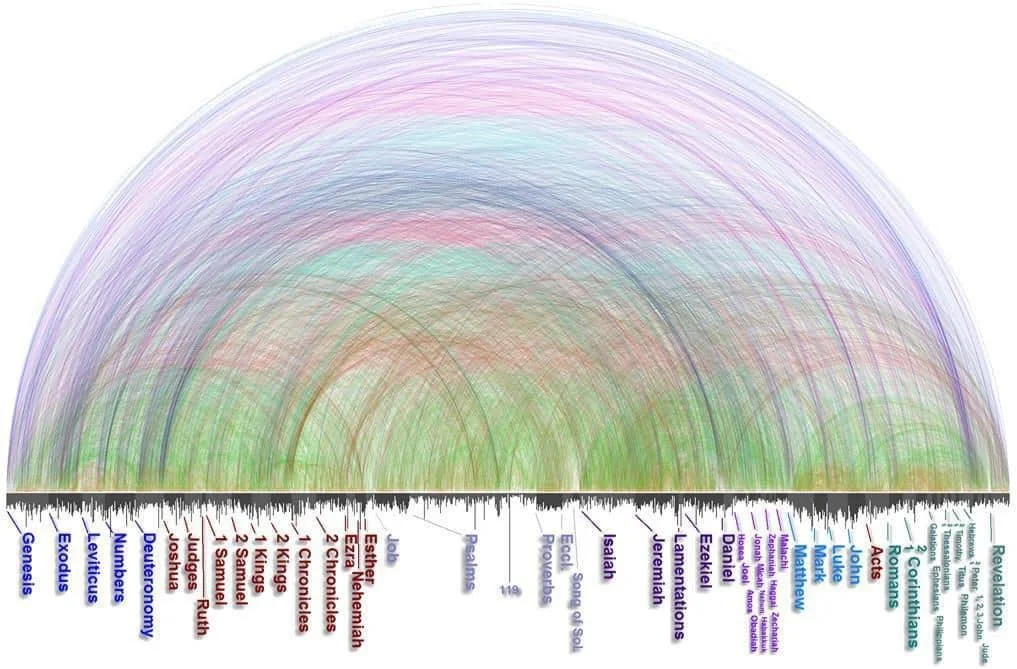
If you take a step back and map the internal data of the 66 books of the Bible, you see something that defies human capability. Forensic data analysts have mapped out the cross-references in Scripture, revealing an extraordinary web of over 63,000 links that seamlessly connect the Old and New Testaments. It looks like a pristine, glowing rainbow of absolute mathematical perfection.
A prophet writes a specific phrase in Isaiah, and 700 years later, a completely different author in a different country writes a sentence in Matthew that perfectly interlocks with it. The entire book is a singular, continuous echo chamber. Why? Because the Holy Spirit is the single Author behind every human pen, and every single book has one singular mission: To reveal the Person of Jesus Christ.
As Jesus Himself told the religious leaders in John 5:39:
"Search the scriptures; for in them ye think ye have eternal life: and they are they which testify of me."
From Genesis to Revelation, Jesus is the focal point. He is the Lamb in Genesis, the Rock in Exodus, the Righteous Branch in the Prophets, and the King of Glory in the New Testament.
Why the Extra Books Snap the Thread
When you run this exact same "Cross-Reference Test" on the extra books (like Tobit, Judith, Bel and the Dragon, or 1 and 2 Maccabees), the beautiful rainbow abruptly stops. The connection breaks. They do not interlock with the rest of the grand design, and here is why:
The Silence of the Lamb (Where is Jesus?): The canonical Old Testament books are pregnant with Messianic expectancy—they are crying out for a Savior, predicting His birthplace, His lineage, His manner of death, and His resurrection.
But when you read the Apocrypha, the Messiah is missing.They do not testify of Jesus.
Instead of pointing to the global redemptive work of the Cross, they are hyper-focused on local political wars, legalistic ritualism, and personal moral fables.
They Don't Connect to the New Testament Horizon: Because the Apocrypha was written during the 400 years of "spiritual silence" between Malachi and Matthew, the authors themselves explicitly admit that the Holy Spirit was not speaking through prophets at that time. In 1 Maccabees 9:27, the author writes that there was great distress “such as had not been since the time that a prophet ceased to appear among them.” Because they lacked the prophetic voice, they couldn't build the cross-reference bridges that connect to the New Testament.
They Introduce Theological "Foreign Objects": If you force these books into the perfect cross-reference loop, they act like an ideological virus in the system, introducing illegal contradictions that ruin the whole picture. As established by the 66 books, salvation is by grace through faith alone, and the Blood of Jesus is the only legal asset that cleanses sin (Ephesians 2:8-9, 1 John 1:7). However, Tobit 12:9 claims: “For almsgiving (giving money) saves from death and purges away every sin.”
The Courtroom Danger: If human money can purge sin debt, then the Cross of Christ was a redundant corporate failure. When a believer embraces these extra-biblical legal fictions, they are attempting to pay off a capital crime using unauthorized, counterfeit currency. This structural compromise invalidates their defensive paperwork at the bench, granting a lingering Rephaim core nucleus the immediate legal permit to anchor an ancestral lien over their lineage. By attempting to buy or ritualistically perform their way out of a curse, they leave the physical rooms of their biological temple chambers entirely unsealed, allowing ground-level demonic shards to occupy their organs and tissue with impunity.
The extra books don’t fit into the Bible for the same reason a plastic puzzle piece doesn’t fit into a wooden puzzle—they were carved by a completely different source. They do not share the divine DNA, they do not know the line to the Cross, and they do not sing the name of Jesus.
The Mathematical Watermark: The Geometry of Psalm 118
If the interconnected, 63,000-link visual rainbow isn't enough to prove the Bible is a closed, divine dossier, the physical geometry of the text seals the case. The enemy wants you to believe that the Bible is a fragile document vulnerable to human editing, erasure, and political manipulation.
But the Creator did something brilliant: He hid a protective, self-authenticating watermark right inside the structural extremes of the book.
Note from the Bench (The Precise Forensic Fact-Check):There is a widespread internet rumor that Psalm 117 is the exact numerical middle of the Bible, and that Psalm 118:8 is the exact center verse down to the single digit. While the absolute mathematical center of words and verses can fluctuate slightly depending on the specific translation, print layout, or publisher, the structural layout of the chapters themselves reveals an unshakeable, hard-coded design that no printing press can alter.
Look at the layout of the Psalms:
The Shortest Boundary: Psalm 117 is the absolute shortest chapter in the entire Bible, containing only two verses.
The Longest Boundary: Psalm 119 is the absolute longest chapter in the entire Bible, spanning a massive 176 verses.
Sitting right between the shortest chapter and the longest chapter is the divine pivot point: Psalm 118. And if you read the exact center of that structural sandwich, Psalm 118:8 delivers the ultimate judicial verdict of the entire canon:
“It is better to trust in the Lord than to put confidence in man.”
Think about the staggering, mathematical irony! The skeptics and religious traditions argue that you cannot trust the 66 books because "human councils and men decided what got left out." Yet, the Holy Spirit engineered the architecture of the book so that right at the extreme structural center, the text screams a warning never to base your spiritual confidence on the authority of men, but to trust the preservation of the Lord. The Bible doesn't just contain the word of God; its very physical geometry mocks the idea that human hands could ever corrupt its final, sovereign design. It is signed, sealed, and watermarked by the Author.
The Hope of the Sealed Docket: The King Preserves His Own Case
Here is where your hope is unshakeably anchored: The preservation of Scripture is not dependent on the frailty of men; it is guaranteed by the sovereignty of the Judge. If God has the cosmic power to create the universe by speaking it into existence, and if He has the legal precision to design an intricate multi-dimensional courtroom ecosystem, it is a legal absurdity to suggest He would allow His own statutory manual to be corrupted or incomplete.
Jesus explicitly guaranteed the indestructible preservation of His legal framework in Matthew 24:35:
"Heaven and earth shall pass away, but my words shall not pass away."
And as the Prophet Isaiah declared in Isaiah 40:8:
"The grass withereth, the flower fadeth: but the word of our God shall stand for ever."
The devil desperately wants you to think the Bible is missing books because if you think the manual is fractured, you won't use it to fight. But the Docket is sealed. The evidence is complete. You hold in your hands the exact, untampered, fully authorized, 66-book constitutional legal authority of the Kingdom of God.
Stop letting the enemy use religious traditions or secular myths to dilute your confidence in the written Word. The Record is clean, the Evidence is airtight, and the law is entirely on your side. Step up to the bench with total, unshakeable boldness, present the written Word, and watch the enemy's false lawsuits collapse.
Keyword: missing books of the bible, canonical audit, rules of spiritual evidence, why apocrypha is not in the bible, how many books in the bible, 66 books of the bible canon, psalm 118 middle of the bible, is the catholic bible missing books, proof the bible wasn't changed by man, why protestants removed apocrypha fact check, historical validity of scripture canonical tests, cross reference rainbow map bible evidence
#MissingBooksOfTheBible #Apocrypha #BiblicalCanon #ScriptureAlone #WordOfGod #Apologetics #BibleFactCheck #TrueScripture #66Books #CrystleClear #CourtroomOfHeaven #KingdomVerdicts #SpiritualWarfare #SpiritualIntelligence #DeceptionUnmasked #FaithOnTrial #TheBench
Questions and Topics Covered:
Is the Bible missing books that were removed by men or political committees?
A: No. The collection of Scripture is not an arbitrary list of books chosen by human political power; it is a recognition of books that inherently carried divine authority from the moment they were written. Books that failed to meet the strict legal standards of divine inspiration were rejected as unauthenticated evidence.
Why does the Catholic Bible include extra books (the Apocrypha) that the Protestant Bible doesn't have?
A: The extra books (like Maccabees, Tobit, and Judith) were never accepted into the Hebrew canon by the Jewish people, were never quoted by Jesus or the Apostles, contain historical and theological errors, and were not officially dogmatized by Rome until the Council of Trent in 1546—long after the original New Testament church was established.
Why don't the extra books (the Apocrypha) connect to the rest of the Bible like the other Old Testament books do?
A: Because they lack prophetic inspiration. The authors explicitly state that prophets had ceased in Israel during their time (1 Maccabees 9:27). Lacking the divine breath of the Holy Spirit, they introduce theological contradictions—such as teaching that human money can purge sin debt. This breaks the unified message of the Gospel and acts like a fraudulent contract. Embracing these extra-biblical legal fictions strips the believer of their direct courtroom defense, authorizing a generational Rephaim core nucleus to anchor itself to the nervous system and feed toxic demonic shards straight into the physical rooms of their biological temple.
What are the strict legal tests used to determine if a book belongs in the Bible?
A: A book had to pass three strict rules of evidence: Apostolic/Prophetic Origin (written by an eyewitness or a prophet authorized by God), Doctrinal Consistency (matching the existing framework without contradiction), and Corporate Authentication (universal recognition and use by the global body of believers).
How does the physical structure of the chapters prove the Bible wasn't manipulated by men?
A: God hid a mathematical watermark in the text. Psalm 117 is the shortest chapter in the Bible, and Psalm 119 is the longest. Sitting right between them is Psalm 118, which contains the verse Psalm 118:8: "It is better to trust in the Lord than to put confidence in man." This structural centerpiece explicitly warns readers against trusting human committees, proving God watermarked the layout to validate His own sovereign preservation over human interference.